Patients ask me about sermorelin more than almost any other peptide. Some have read that it is a gentler way to raise growth hormone. Others have heard that it was once FDA approved and wonder why it disappeared. Both questions deserve a straight answer from the human data, so this post goes back to the studies in older adults and to the FDA record.
What sermorelin is
Your hypothalamus, a small region at the base of the brain, releases growth hormone releasing hormone, or GHRH. That signal travels a short distance to the pituitary gland and tells it to release growth hormone in pulses, mostly at night. Growth hormone then drives the liver to make IGF-1, which carries many of its effects on muscle, bone and skin. The Cleveland Clinic has a clear primer on human growth hormone.
Sermorelin is built on the first 29 amino acids of GHRH, the part that carries its activity. That detail matters. Sermorelin does not replace growth hormone. It asks your own pituitary to make more, and the body's normal feedback brakes still apply. The history of how these brain hormones were found, with hundreds of thousands of animal brains processed for tiny amounts, is in my physician read on Guillemin, Schally and the hypothalamic hormones.
Approved, then gone
Sermorelin was sold in the United States as GEREF by EMD Serono. One form was approved to test how well the pituitary can release growth hormone, and another to treat growth failure in children with growth hormone deficiency, a condition MedlinePlus covers under growth disorders.
Then the company stopped making it. The FDA notice in the Federal Register records that EMD Serono discontinued GEREF in 2008, that the approvals were withdrawn at the company's request in 2009, and that in 2013 the FDA determined the product was not withdrawn for reasons of safety or effectiveness. That is a narrow legal finding. It is not a new approval, and it does not say the drug works for aging.
What the 1997 study did
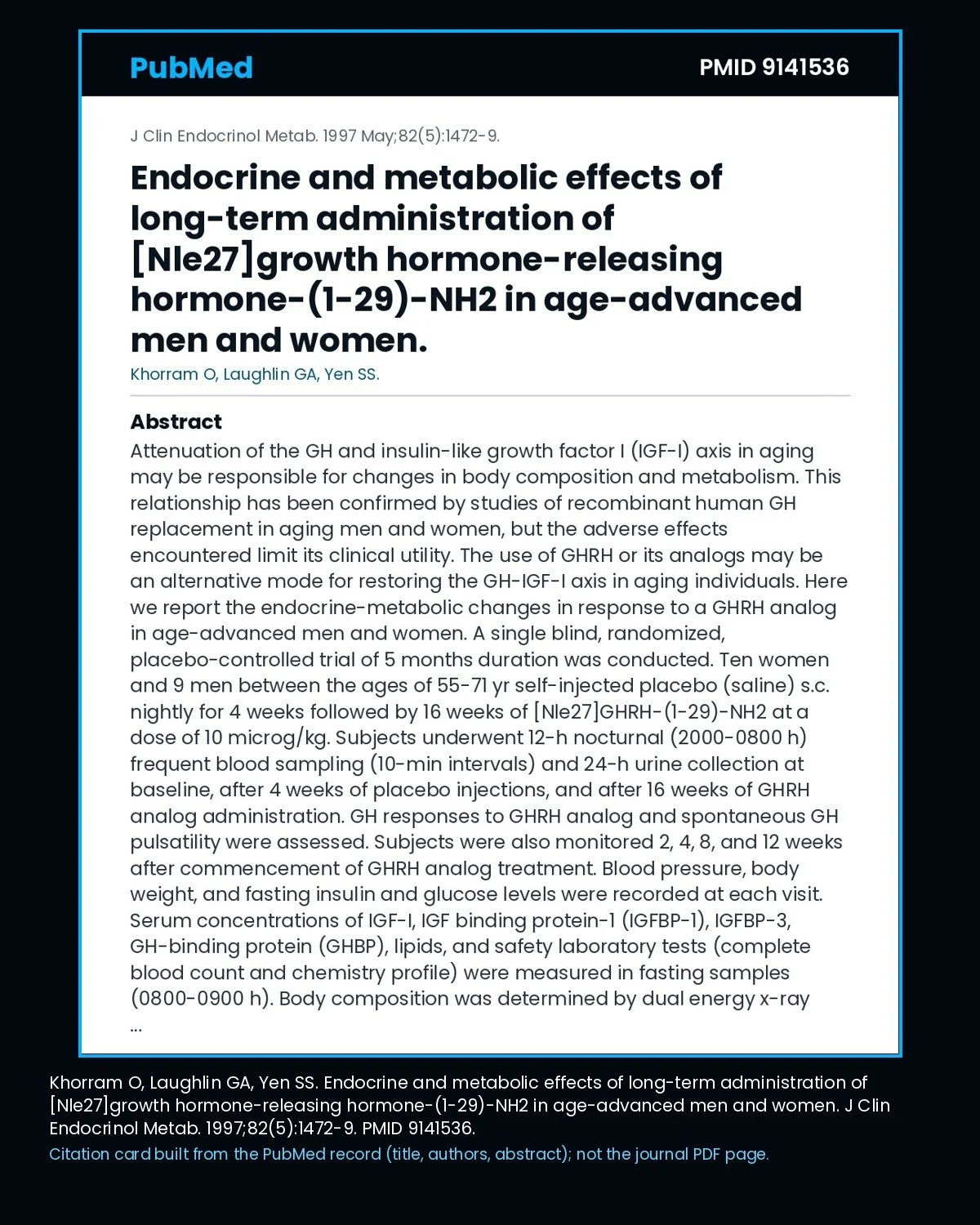
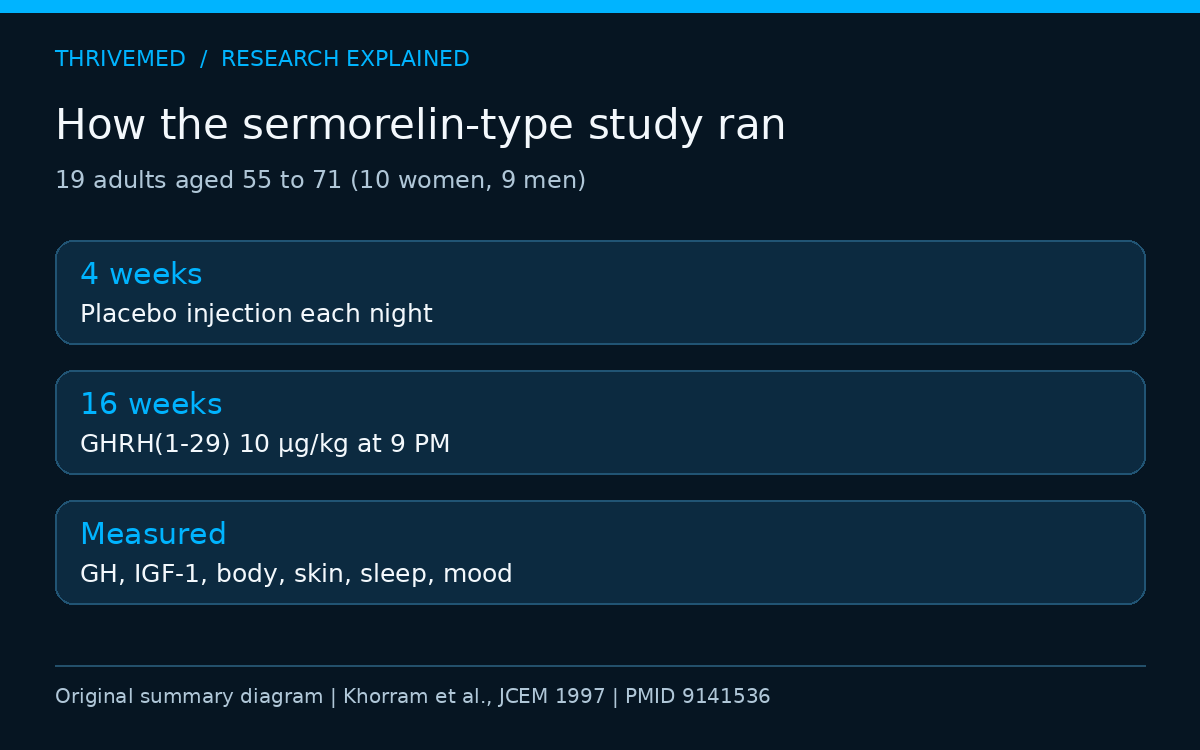
The best-known human study in older adults is by Khorram, Laughlin and Yen, published in the Journal of Clinical Endocrinology and Metabolism. They enrolled 10 women and 9 men aged 55 to 71. Everyone injected placebo under the skin each night for 4 weeks, then switched to 16 weeks of a GHRH(1-29) analog at 10 micrograms per kilogram.
The team measured growth hormone every 10 minutes overnight, along with IGF-1 and related proteins, body composition by DEXA scan, skin thickness, insulin sensitivity, blood fats and quality of life questionnaires that included sleep.
What changed
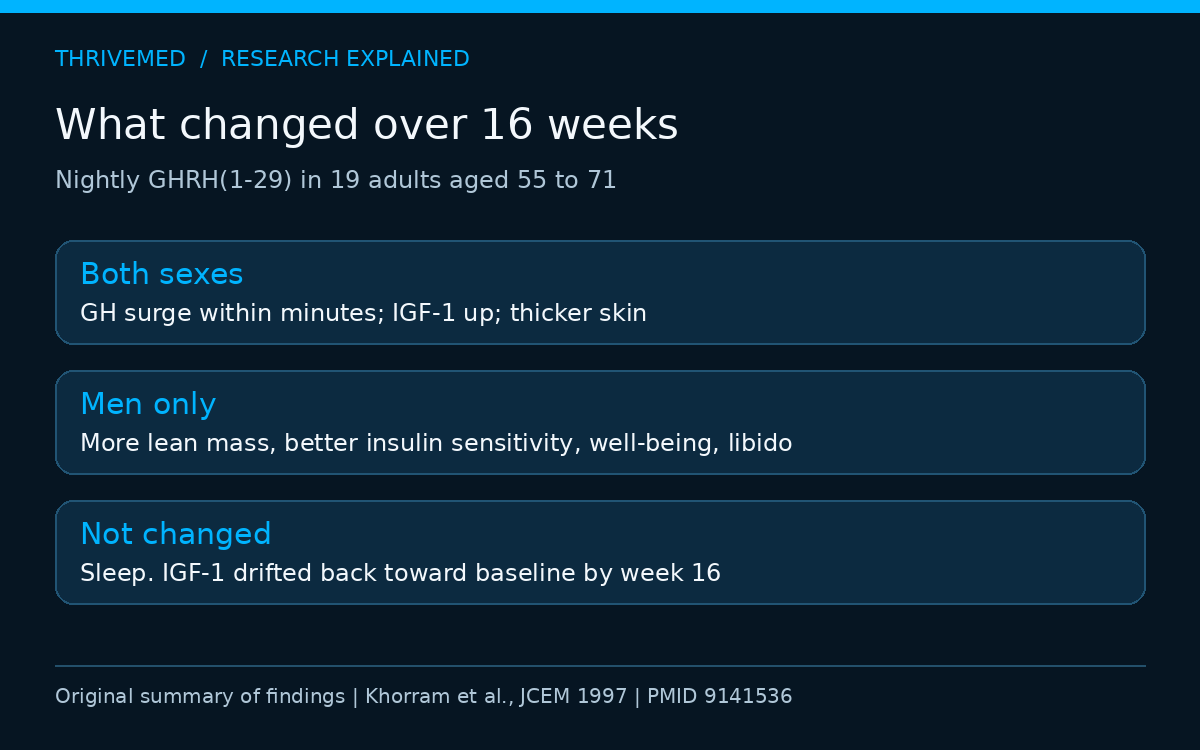
Each nightly dose released growth hormone within 10 minutes, and the rise lasted about 2 hours. The effect held across the study. Compared with placebo, overnight growth hormone rose in both women and men.
IGF-1 and IGFBP-3 rose within 2 weeks and stayed up for 12 weeks, then drifted back toward baseline by week 16. That drift is a detail people often miss when they read marketing claims.
Skin thickness increased in both men and women. Lean body mass, insulin sensitivity, general well-being and libido improved in the men only. Blood pressure, body weight and bone density did not change, and sleep quality did not change in either sex. The only side effect reported was a temporary rise in blood fats that resolved by the end of the study.
A second study, and a different picture
A separate study in Metabolism gave 11 healthy men aged 64 to 76 a nightly dose of 2 mg GHRH for 6 weeks. Night-time growth hormone release went up. But IGF-1 did not change, and body composition by DEXA did not change. Two of six strength measures improved, upright row and shoulder press, along with an abdominal endurance test. The authors concluded that a single nightly dose was less effective than multiple daily doses at producing growth hormone and IGF-1 effects.
Put the two studies side by side and a pattern appears. Sermorelin-type peptides reliably raise growth hormone. Whether that turns into meaningful changes in muscle, strength or metabolism depends on dose, schedule, sex and how long you measure.
The limits of the evidence
These are small studies: 10 women and 9 men in one, 11 men in the other. The 1997 study used a placebo lead-in rather than a parallel placebo group for the full 16 weeks, so everyone knew the active phase came second. Neither study looked at fractures, falls, heart outcomes or longevity. There is no large modern trial of sermorelin for aging.
That does not erase what patients feel. If you felt better on a peptide, that experience is real, and the 1997 data on well-being and libido in men line up with what some of my male patients describe. The honest summary is that the potential is there, the human data are thin, and men and women did not respond the same way. I make the same point about a related peptide in my video on ipamorelin's biggest human trial.
Two things you can use
- If you are considering any growth hormone peptide, ask which outcomes were actually measured in people like you, and for how long.
- Ask your doctor to check IGF-1 and blood fats before and during any growth hormone related treatment, since IGF-1 can drift back and blood fats can rise.
If you are weighing this for muscle loss with age, read up on sarcopenia and the MedlinePlus healthy aging guide first, because strength training and protein still carry the strongest evidence. More from the series: the Peptide Breakthroughs collection, the ThriveMed story of the brain's hormones, and my episode on kisspeptin as an IVF trigger.
Sources
Khorram O, Laughlin GA, Yen SS. Endocrine and metabolic effects of long-term administration of [Nle27]GHRH-(1-29)-NH2 in age-advanced men and women. J Clin Endocrinol Metab 1997;82(5):1472-9. PubMed record (primary). Journal article.
Vittone J et al. Effects of single nightly injections of GHRH 1-29 in healthy elderly men. Metabolism 1997. PubMed record.
FDA. Determination that GEREF (sermorelin acetate) injection was not withdrawn from sale for reasons of safety or effectiveness. Federal Register 2013;78(42):14095.
Comment and I'll send you the paper.