The Hypothalamic Hormones, 1969 to 1977: A Physician’s Read on Guillemin, Schally and Yalow
By Andres Zuleta, MD · Prefer the patient version? Read it on the ThriveMed blog
Almost every week I order a TSH. It is one of the most routine tests in medicine. It is also the downstream echo of a molecule that took 300,000 sheep hypothalami to isolate, in a quantity of one milligram, late in 1968.
The 5-minute story.
The question
By the 1950s the pituitary was understood to drive the thyroid, adrenals and gonads, and the hypothalamus was suspected to control it through the portal vessels described in 1930. The hypothesis was humoral: the hypothalamus releases factors into portal blood. Proving it meant isolating substances present at "a few nanogram quantities" per fragment.
Two strategies, one race
Guillemin and Schally worked together at Baylor from 1957 until Schally left for the New Orleans VA in 1962. The Nobel committee's phrase for what followed was "a formidable race." Guillemin's group processed more than 5 million sheep brains, "more than 50 tons of hypothalamic fragments." Schally's lab worked from about a million pig hypothalami donated by a meat company.
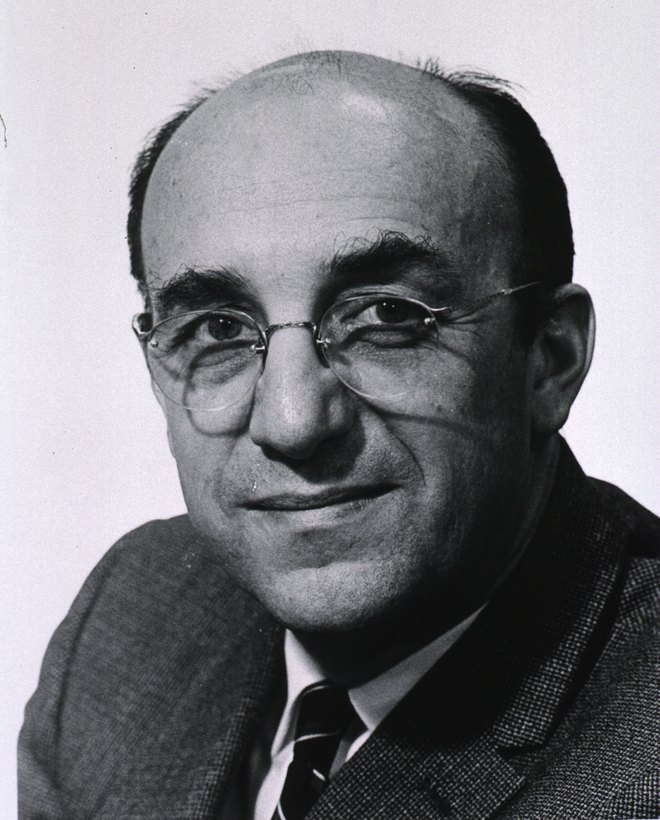
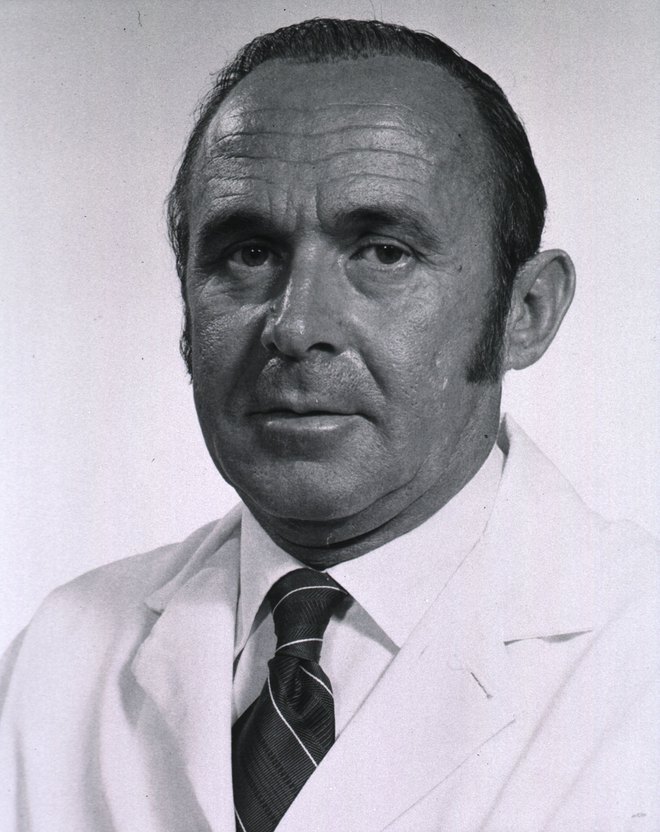
Roger Guillemin and Andrew V. Schally (Lasker Awards Archives, National Library of Medicine, public domain).
What the record shows
- TRH, 1969: pGlu-His-Pro-NH2, a tripeptide. Schally's group (porcine) in BBRC on November 6; Guillemin's group (ovine, structure by mass spectrometry) in C R Acad Sci on November 12. Identical molecules.
- GnRH, 1971: a decapeptide, sequenced first by Schally's group (Matsuo et al., June 1971), with Guillemin's group shortly after. One peptide releases both LH and FSH. Both groups synthesized it on solid phase, the method from Episode 5.
- Somatostatin, 1973: a 14 amino acid peptide from ovine hypothalamus that inhibits growth hormone secretion (Brazeau et al., Science). Found while searching for a growth hormone releasing factor; the first identified inhibitor of pituitary function.
- Radioimmunoassay: Yalow and Berson, J Clin Invest 1960. Competitive displacement of labeled insulin from antibody, with sensitivity the Nobel committee put at 10 to 20 picograms for insulin.
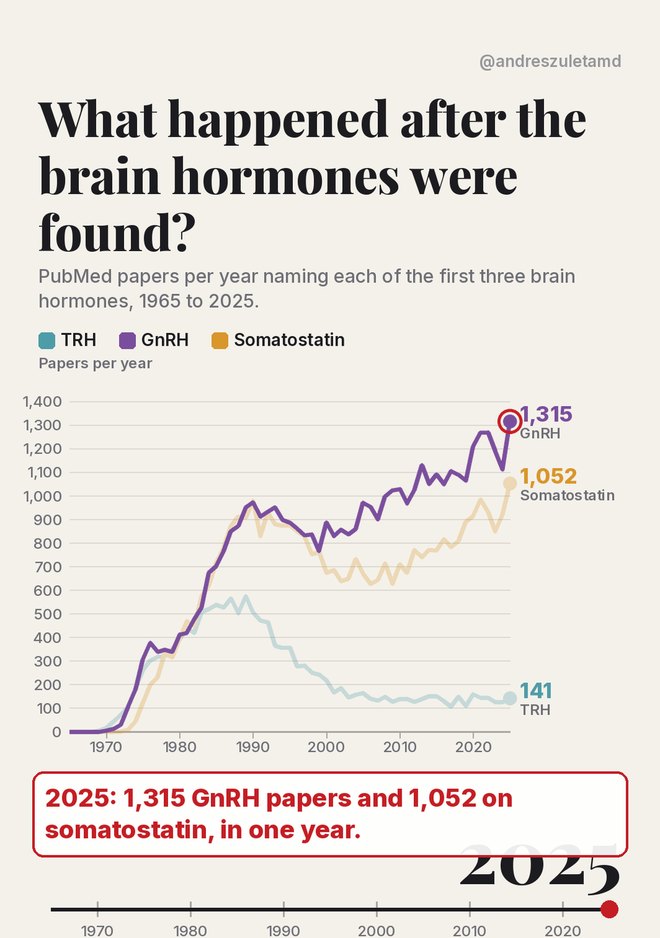
PubMed papers per year naming TRH, GnRH or somatostatin, 1965 to 2025. Early years read low because older records rarely carry abstracts (NCBI PubMed, searched Oct 9, 2026).
The pharmacology twist
The clinically decisive finding came after the prize. Belchetz and colleagues (Science, 1978) showed that intermittent GnRH sustains gonadotropin secretion while continuous exposure suppresses it. That paradox is the basis of GnRH agonist therapy: leuprolide, a nonapeptide analog first approved in 1985, produces sustained receptor occupancy that down-regulates LH and FSH and lowers testosterone and estrogen. Indications include advanced prostate cancer, endometriosis, uterine fibroids and central precocious puberty. The adverse effects are the effects of low sex hormones, including hot flashes and bone loss with long use.
Somatostatin took a different path. Its plasma half-life of 1 to 3 minutes made it impractical, so it was redesigned. Octreotide, an octapeptide first approved in 1988, has a half-life of 1.7 to 1.9 hours and is used in acromegaly and for symptom control in certain hormone-secreting tumors.
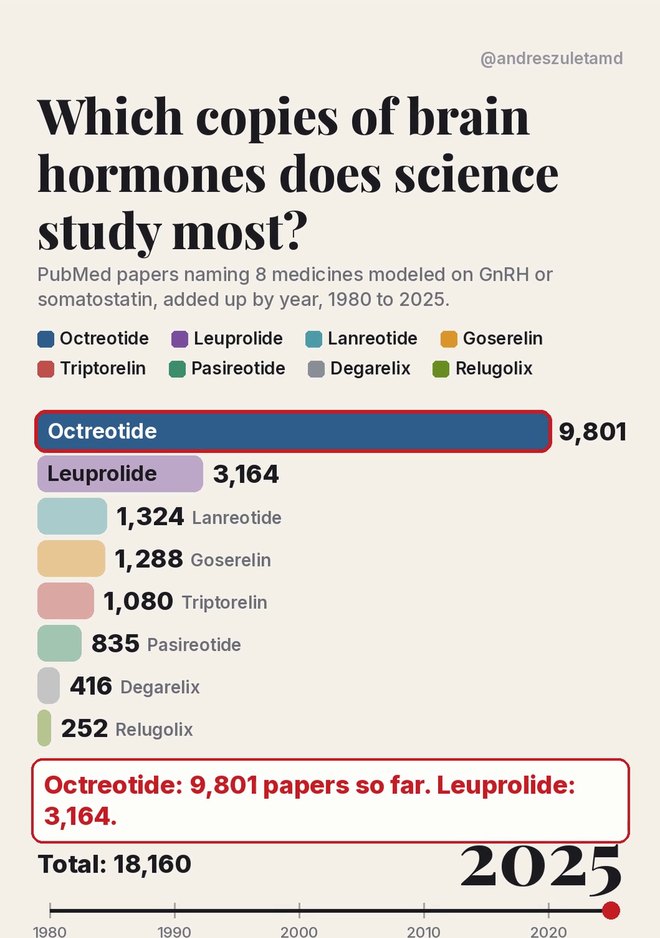
Cumulative PubMed papers naming 8 medicines modeled on GnRH or somatostatin, 1980 to 2025 (NCBI PubMed, searched Oct 9, 2026).
What it means clinically
Three habits I take from this story. First, read endocrine labs as a chain: gland, pituitary, hypothalamus. A TSH is a pituitary answer to a brain signal. Second, respect timing. The same ligand can stimulate or suppress depending on its pattern. Third, respect the limits of analogs. These are potent prescription medicines with real effects beyond the target, not general wellness tools.
The physicist
Then there is the other half of the prize. A graduate chairman told her that her A minus "confirms that women do not do well at laboratory work." She built the assay anyway, in a converted janitor's closet at the Bronx VA, with Solomon Berson, who died in 1972 and could not share the prize. Her own description: "a stubborn, determined graduate student."
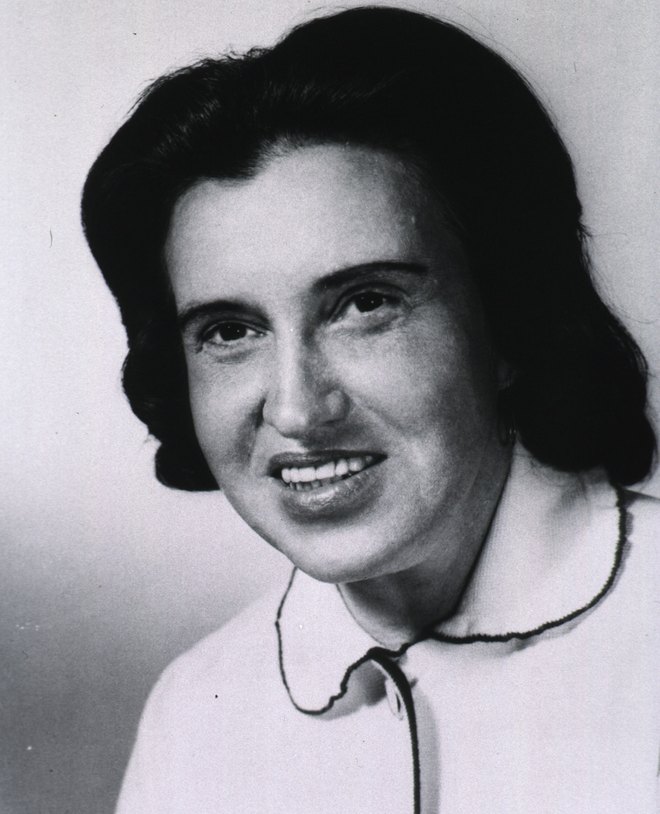
Rosalyn S. Yalow (National Library of Medicine, public domain).
Want a proactive plan for your own health? Join Thrive Nation.
Sources: Nobel Prize in Physiology or Medicine 1977, press release; Guillemin and Schally Nobel lectures, Dec 8, 1977; Nobel biographies (nobelprize.org); Boler J et al., BBRC 1969;37:705; Burgus R et al., C R Acad Sci D 1969;269:1870; Matsuo H et al., BBRC 1971;43:1334; Brazeau P et al., Science 1973;179:77; Belchetz PE et al., Science 1978;202:631; Yalow RS, Berson SA, J Clin Invest 1960;39:1157; NIH NLM StatPearls, Leuprolide (NBK551662); NIH LiverTox, Leuprolide; FDA label for octreotide, NDA 019667. Chart data: NCBI PubMed, Oct 9, 2026.
Educational only, not medical advice.