Solid Phase Peptide Synthesis, 1963: A Physician’s Read on Merrifield’s Bead
By Andres Zuleta, MD · Prefer the patient version? Read it on the ThriveMed blog
On May 26, 1959, Bruce Merrifield wrote in notebook #321 at the Rockefeller Institute: "There is a need for a rapid, quantitative, automatic method for the synthesis of long chain peptides. A possible approach may be the use of chromatographic columns where the peptide is attached to the polymeric packing and added to by an activated amino acid, followed by removal of the protecting group and with repetition of the process until the desired peptide is built up. Finally the peptide must be removed from the supporting medium."
That paragraph is, almost line for line, the method that won him the 1984 Nobel Prize in Chemistry. This is Episode 5 of The Peptide Breakthroughs.
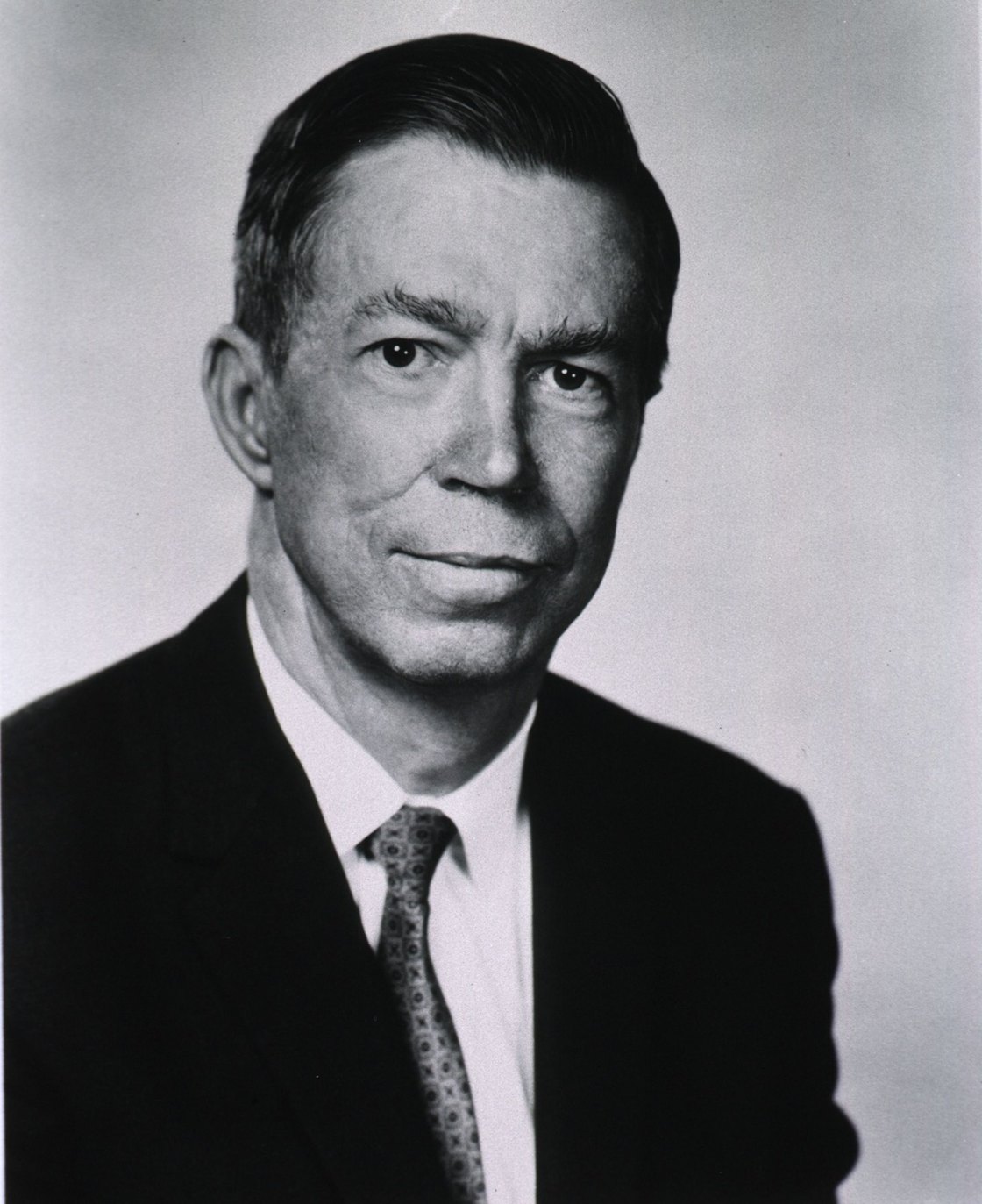
R. Bruce Merrifield, 1969 Lasker Award photo (National Library of Medicine, public domain).
The problem he was solving
Classical solution synthesis isolated and purified every intermediate. Merrifield's own benchmark: a five-residue strepogenin peptide (Ser-His-Leu-Val-Glu) took him 11 months at a 7% yield. Each isolation step loses material, and the losses multiply.
The method, in one paragraph
The C-terminal amino acid is anchored covalently to an insoluble support: polystyrene cross-linked with 1% divinylbenzene, beads about 50 µm across when dry that swell 5 to 6 fold in solvent. Then the cycle runs: remove the temporary protecting group, neutralize, couple the next protected amino acid with an excess of activated reagent, and filter and wash. Excess reagent drives each coupling toward completion, and the wash replaces crystallization. At the end, a strong acid cleaves the chain from the resin and removes the side-chain protection. The 1963 J Am Chem Soc paper demonstrated it on a tetrapeptide, Leu-Ala-Gly-Val.
The math that decides everything
The Nobel committee's own example: at 90% per step, 100 steps give 0.003% overall; at 99.5%, 61%. That is why the method lives or dies on per-step completeness and side reactions, and why, in Merrifield's words, much of his lab's effort went into making each step fast, high-yield and free of side reactions. It is also the right frame for any synthetic peptide today: every incomplete step leaves wrong chains behind that must be removed and measured.
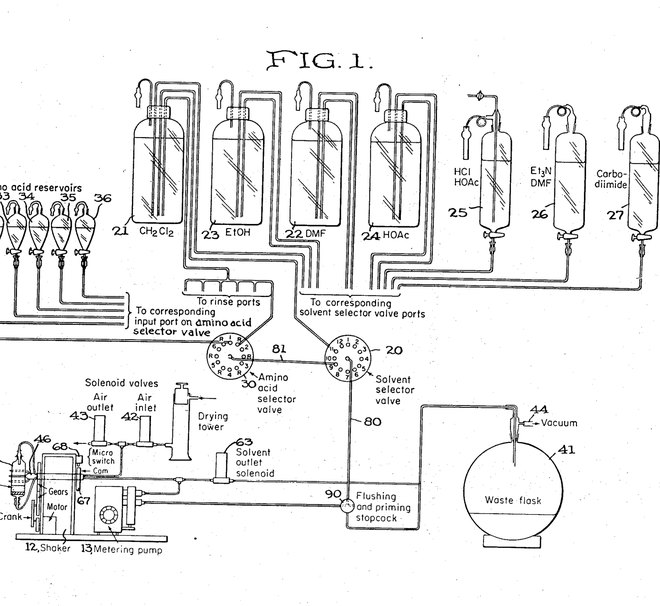
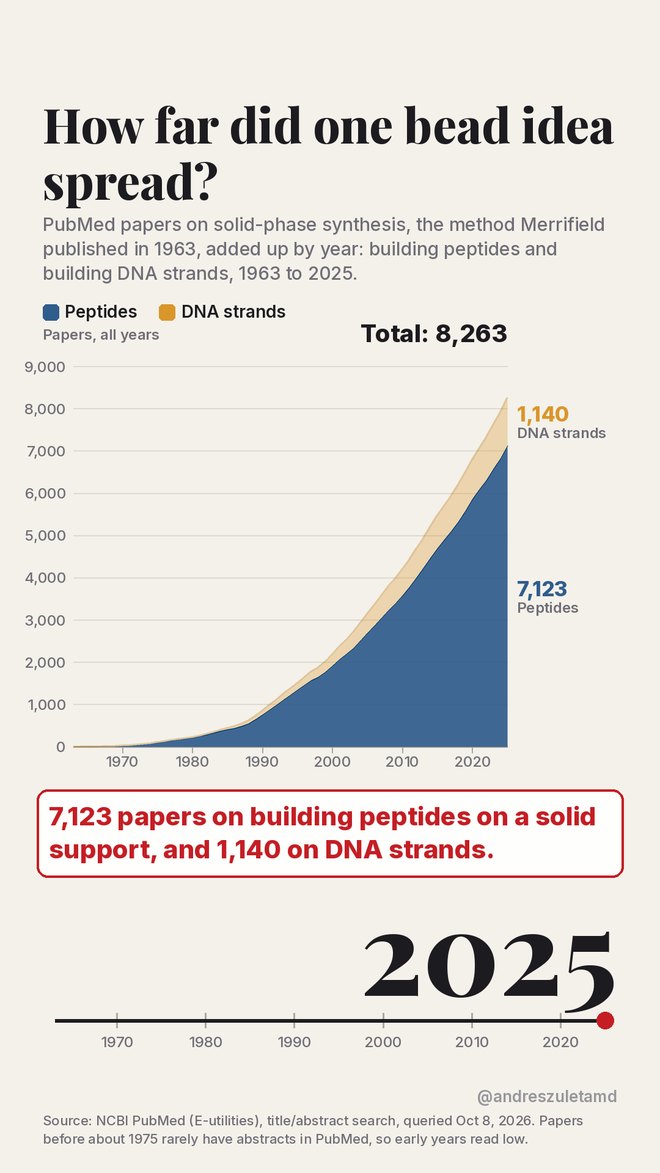
Left: the automated synthesizer, US Patent 3,531,258 (1970, public domain). Right: PubMed papers on solid phase synthesis of peptides and of DNA strands, cumulative to 2025 (searched Oct 8, 2026; early years undercounted because old records rarely have abstracts).
What the record shows
- 1965: Merrifield and Stewart report automated synthesis (Nature 207:522); the instrument, built with Nils Jernberg, used "a simple stepping drum programmer and a set of timers."
- 1966: Marglin and Merrifield, bovine insulin by the solid phase method (J Am Chem Soc 88:5051).
- 1969: Gutte and Merrifield, ribonuclease A, 124 residues: 369 chemical reactions and 11,931 operations in about three weeks. Honest result: about 3% overall yield after purification, about 80% of native specific activity, and in Merrifield's words, "We could not claim that our product was completely pure."
- By 1984: "up to 50 or somewhat more residues can be readily achieved in good yield and purity"; salmon calcitonin (32 residues) made in 50 to 100 g batches.
The critics, and the mentor
Early reception was cold: "not chemistry at all," an "ingenious trick," and in 1971 a prominent chemist called it unsuitable for natural peptides over 15 residues. Merrifield had expected three months of development and needed three years without a publishable result. His supervisor, D. Wayne Woolley, born with diabetes and blind since his twenties, let him persist. A picture of Woolley hung over Merrifield's desk when the Nobel call came.
What it means clinically
- Manufacturing of today's peptide medicines. Enfuvirtide (36 residues) is made by Fmoc solid phase synthesis of three fragments followed by solution phase condensation, with impurity limits justified by toxicology studies (EMA EPAR). Lilly's tirzepatide (39 residues) process combines solid phase and solution phase steps at kilogram scale (Frederick et al., Org Process Res Dev 2021).
- Quality is a process property. A sequence on paper says nothing about the impurities left in a batch. For patients asking about any peptide, the useful questions are how it was made and how it was tested.
- Beyond peptides. The Nobel committee noted in 1984 that the same idea had been applied to automated synthesis of oligonucleotides, the short DNA strands used in research.
Two takeaways
- Per-step quality compounds. Ask how it was made, and how it was tested.
- Good ideas need runway, and someone willing to grant it.
Want a proactive plan for your own health? Join Thrive Nation.
The Peptide Breakthroughs: Previous, Episode 4: insulin, the first protein sequence. Next, Episode 6: the race to find the brain's hormones.
Sources: Merrifield RB, J Am Chem Soc 1963;85:2149-2154 (doi.org/10.1021/ja00897a025); notebook #321 (Science History Institute; Rockefeller Digital Commons); Merrifield and Stewart, Nature 1965;207:522 (doi.org/10.1038/207522a0); Merrifield, Stewart and Jernberg, Anal Chem 1966;38:1905; Marglin and Merrifield, J Am Chem Soc 1966;88:5051 (doi.org/10.1021/ja00973a068); Gutte and Merrifield, J Am Chem Soc 1969;91:501 (doi.org/10.1021/ja01030a050); Merrifield, Nobel lecture, Dec 8, 1984; Nobel press release, Oct 17, 1984; Mitchell AR, LLNL UCRL-PROC-231884 (2007), quoting Wünsch E, Angew Chem 1971; Science History Institute, R. Turner, May 18, 2021; EMA EPAR Fuzeon; Frederick MO et al., Org Process Res Dev 2021;25:1628 (doi.org/10.1021/acs.oprd.1c00108).
Educational only, not medical advice.