AI-Initiated Acne Prescriptions in Utah: A Physician’s Read of the Nolla Health Agreement
By Andres Zuleta, MD · For the patient friendly version, see the ThriveMed blog.
On September 22, 2026, Utah's Office of Artificial Intelligence Policy and Division of Professional Licensing signed a regulatory mitigation agreement with Magic Health, Inc. and Magic Health Services, LLC, doing business as Nolla Health. The registry lists the term as October 5, 2026 to October 5, 2027. It is the first pilot on Utah's registry in which an AI system initiates a new prescription rather than renewing one. Here is how I read the document.
What was granted, exactly
- Instrument: a regulatory mitigation agreement under the Artificial Intelligence Learning Laboratory Program (Utah Code 13-72-301 and 13-72-401). Twelve months from commencement, with up to two extensions of up to 12 months.
- Mitigation: the Division forgoes enforcement of specific unlicensed practice, unprofessional conduct and telehealth provisions (Schedule A) solely when the AI issues first time topical acne prescriptions and renewals to eligible Utah residents 18 and older and transmits them to a Utah licensed pharmacist. The protection extends to physicians who rely on the system for that action. It reaches no other service.
- Not an endorsement: section 3E states the agreement "does not constitute an endorsement or approval from the State of Utah."
- Context: Utah's earlier healthcare pilots (Doctronic, Legion Health) are renewal only. Reporting by Utah Business notes the Utah Medical Licensing Board objected to the Doctronic renewal pilot; Nolla says it met with the board before launch.
How the system is bounded
- Inputs: identity verification (government photo ID and selfie), Utah residency checks, a structured intake, and a five angle facial image sequence behind an automated image quality gate.
- Severity: a vision transformer regresses a continuous IGA score (0 to 4) from the images, not from self report.
- Selection: a language model layer combines the score with intake data to choose from 8 topical formulations (four tretinoin based, two of them with topical spironolactone; adapalene; clindamycin with benzoyl peroxide; benzoyl peroxide; azelaic acid; most with niacinamide). No oral, systemic hormonal or isotretinoin therapy; no free text in the prescription flow. Each patient receives both a morning and an evening treatment (Schedule B 4.3); niacinamide 4% is in 6 of the 8, and spironolactone 1% is available compounded only.
- Hard stops: under 18, failed identity check, pregnancy or lactation or trying to conceive, immunosuppression, severe renal or hepatic disease, prior reaction to a formulary agent, non Utah address, persistent poor images. IGA above 3.5 routes to physician review before any prescription; IGA 4.0 is directed to in person care.
- Transparency: prescriptions are transmitted under the overseeing physician's NPI and flagged as AI initiated; pharmacists receive a physician contact.
This is the insight worth sharing: it is not that the model is smart. It is that the task is bounded, and the agreement spells out the bounds.

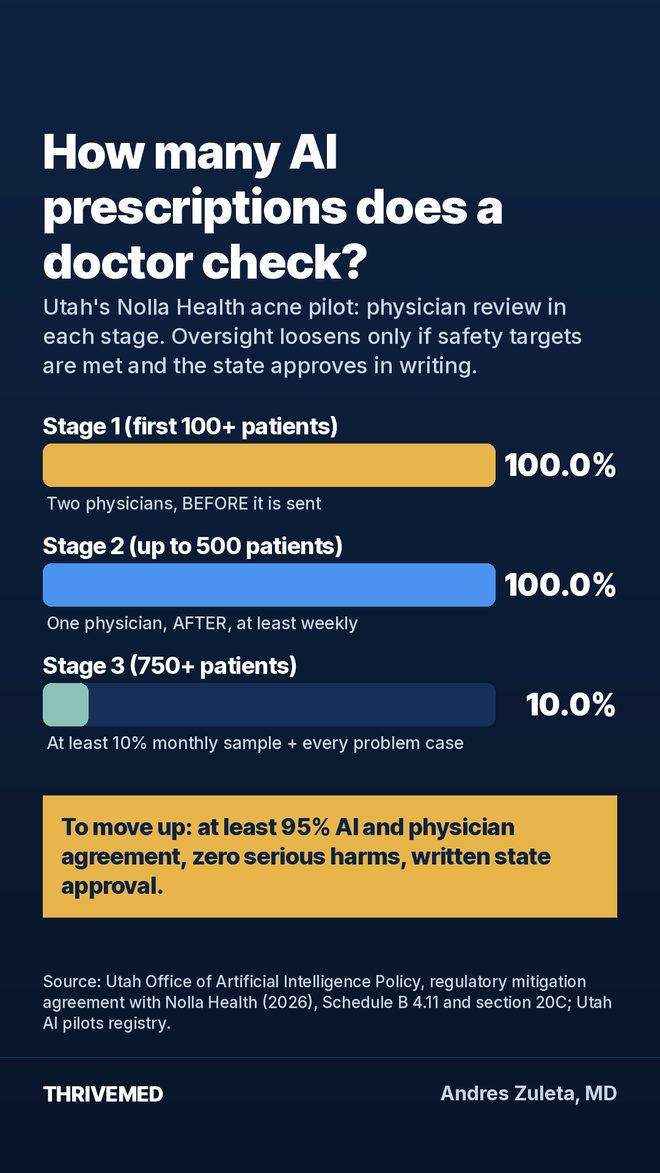
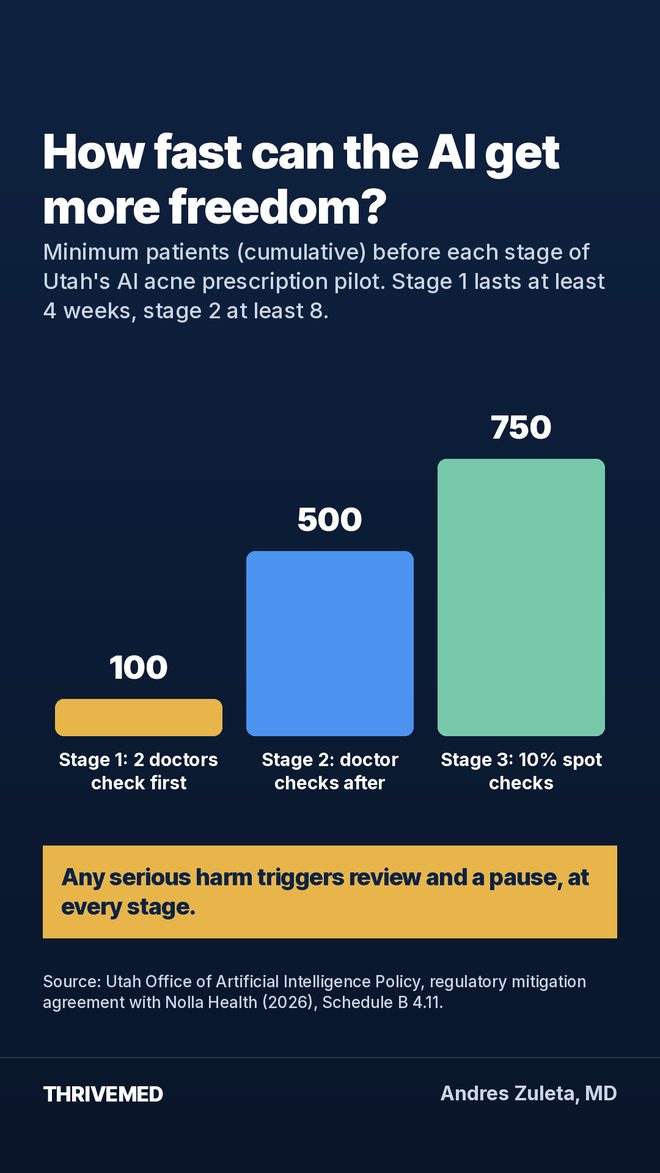
Stage gated oversight
| Stage | Minimum | Physician role |
|---|---|---|
| 1 | 4 weeks, 100 patients | Dual independent pre-submission review of every prescription |
| 2 | 8 weeks, 500 cumulative | Retrospective review of every case, at least weekly |
| 3 | 750 cumulative | Monthly sample of at least 10%, plus every escalation or adverse event |
Gate criteria at every stage: at least 95% AI and physician concordance, zero missed hard stops after QA, zero serious adverse events, and prior written approval from the Office. A serious adverse event triggers review and pause.
Reporting obligations
Adverse events within 24 hours, with a broad definition that includes misdiagnosis, missed contraindications, incorrect dosing, failure to escalate, hallucinated patient facts and identity verification failures. Monthly reports cover agreement rate by drug, escalation reasons, sampled chat logs, clinician observations, and outcomes and agreement by age, gender and race. Quarterly public reports and a final report are required. The company must also carry professional liability insurance, may not sell patient data, and may not limit its liability for harm in its terms.
What the evidence shows, and does not
- Company validation (proposal, not peer reviewed): trained on more than 100,000 labeled cases; on a held out set of 10,348 cases, R squared 0.947 against expert severity scores.
- Company real world data: about 96% clinician agreement across its last 1,000 treatments, with the remainder one step strength changes.
- Not yet available: peer reviewed outcomes (clearance, irritation, discontinuation, scarring), performance across skin tones, and independent analysis. Agreement with a physician choosing from the same short list is a process measure, not a patient outcome.
What I would want to see next
- The first quarterly public report, with agreement by drug and escalation rates.
- Outcome data at 8 to 12 weeks, stratified by skin tone and severity.
- Independent review of the hard stop QA, especially pregnancy screening for retinoid prescriptions.
Bottom line
This is a carefully bounded test of AI initiated prescribing in a low acuity, guideline driven condition, with physicians in the loop and a state that can see and stop it. The agreement design is more thoughtful than the headlines. The evidence is still mostly the company's. Watch the public reports. Be proactive.
Sources: Utah Office of Artificial Intelligence Policy and Division of Professional Licensing, regulatory mitigation agreement with Magic Health, Inc. and Magic Health Services, LLC (Nolla Health), Schedules A and B, 2026; Utah AI Authorized Pilots registry; Nolla Health and PR Newswire, October 5, 2026; Utah Business, October 6, 2026; Reynolds et al., J Am Acad Dermatol 2024;90(5):1006.e1. Educational only, not medical advice. Video footage: Pexels, Pixabay and Mixkit (free licenses); app footage from Nolla Health's launch video (editorial excerpt).