Aletta and the First Autonomous Blood Draw: A Physician’s Read of the De Novo and the ADOPT Trial
By Andres Zuleta, MD · For the patient friendly version, see the ThriveMed blog.
On August 19, 2026, FDA granted Vitestro's De Novo request for the Aletta Autonomous Robotic Phlebotomy Device (Gen1 US), DEN250046, and in doing so created a new Class II device type: 21 CFR 880.6975, robotic peripheral venous blood collection system (product code SIW). FDA called it "the first standalone robotic device that can draw blood from a patient's arm without hands-on operator intervention." Here is how I read the regulatory record and the evidence.
What was authorized, exactly
- Indication: autonomous, ultrasound guided venipuncture and blood collection for diagnostic purposes in adult outpatients, monitored by a trained phlebotomist, who may supervise up to three devices simultaneously. Prescription device.
- Pathway: Direct De Novo under section 513(f)(2); received September 26, 2025; granted August 19, 2026. Future devices of this type need a 510(k) against this classification.
- Special controls include clinical testing of first puncture success, sample quality and quantity, adverse events, and subgroup analyses (skin tone, BMI, anticoagulation, known difficult IV access), plus labeling that states the expected rate of referral to manual phlebotomy.
How it works
Near-infrared imaging selects a start position; ultrasound scans the antecubital fossa; Doppler distinguishes veins from arteries. Insertion proceeds only when vein criteria (size, depth, orientation) are met, at a standardized speed and a 10 to 30 degree angle, with a single use 21G set. Tubes are filled and inverted automatically (9 inversions), and the supervising phlebotomist verifies order of draw and fill. If no suitable vein is found, no attempt is made; excessive movement detaches the needle.
What ADOPT shows
Giesen et al., Clinical Chemistry 2026 (NCT05878483), three Dutch outpatient phlebotomy departments:
| Measure | Result |
|---|---|
| Screened by the device (cohort 2) | 1,743 |
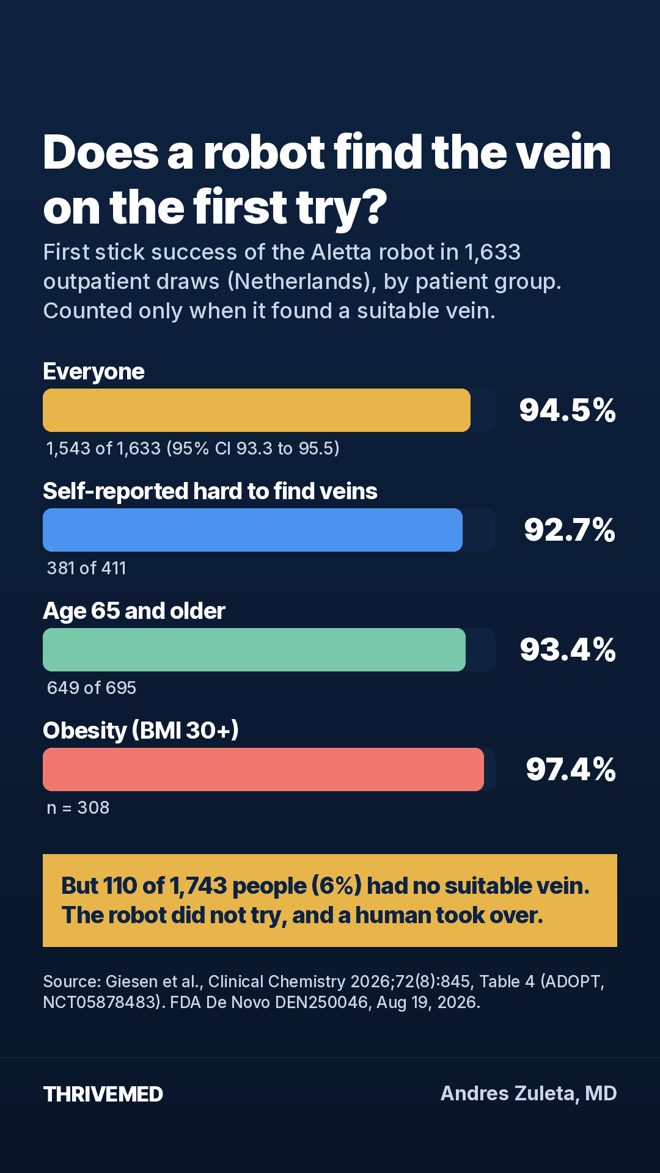
| No suitable vein, referred to manual (screen out) | 110 (6%) |
| Device venipunctures | 1,633 |
| First stick success | 94.5% (95% CI 93.3 to 95.5) |
| Difficult venous access / age 65+ / BMI 30+ | 92.7% / 93.4% / 97.4% |
| First stick success, all screened (derived) | 88.5% (1,543 of 1,743) |
| Adverse events (all mild) | 0.6%: vasovagal 5, syncope 2, hematoma 2, paresthesia 1 |
| Hemolysis | 0.3% (site range 0% to 5.2%) |
| Median procedure time | 2 min 37 s |
| Analytical equivalence (cohort 1, n=153) | aPTT, PT, LDH, AST, platelets: no significant differences |
Patient experience (about two thirds surveyed): 51% reported less pain, 39% similar, 10% more; 47% preferred the device, 35% had no preference, 18% preferred manual.
What it does not show
- No concurrent control. Cohort 2 was single arm; comparisons are to literature. FDA's phrase, "comparable to or better than trained human phlebotomists when it proceeds with a stick," carries that conditional.
- Skin tone. The paper notes no ancestry information was collected, and the companion editorial (El-Khoury, Clin Chem 2026) is titled "Exceptional Performance. Unproven Generalizability across Skin Tones." FDA states the reviewed data spanned varying skin tones; I would like that subgroup published, as the special controls require it in labeling.
- Sponsor role. Vitestro funded the trial and participated in design, data interpretation and manuscript preparation; several authors hold equity.
- Setting. Dutch outpatient departments; US performance in real use is untested. Vitestro plans a US multicenter trial before US commercial availability. Tests sensitive to extra inversions (potassium was named) were not evaluated.
My read
The design choice I respect most is the refusal rule: the device screens out about 1 in 16 patients rather than attempting a doubtful stick, and the labeling must disclose that referral rate. That is the right failure mode. If US data confirm these numbers across skin tones and in busy real world draw rooms, one phlebotomist supervising three devices could ease a workforce that BLS counts at 143,900 with about 18,000 openings a year, and free skilled hands for the hardest veins.
For patients: hydrate if the test allows, keep the arm warm, name the arm that worked last time, and know that you can always ask for a person.
Sources
- FDA press release, Aug 19, 2026: fda.gov · De Novo order DEN250046: PDF · database entry
- Giesen LFP, Roest JA, Koopman FMA, et al. Clin Chem 2026;72(8):845. doi:10.1093/clinchem/hvag029 · NCT05878483
- El-Khoury JM. Clin Chem 2026;72(8):819-820. doi:10.1093/clinchem/hvag045
- Vitestro announcements: Aug 20, 2026, Apr 14, 2026
- BLS Occupational Outlook Handbook, Phlebotomists: bls.gov
The patient friendly version is on the ThriveMed blog. Want a proactive plan for your own health? Join Thrive Nation.
Educational only, not medical advice.