Every parent who has taken a child for glasses knows the routine. Drops go in, you wait, a machine takes a reading, and then the eye doctor works lens by lens: "Better with one, or two?" A new study in Translational Vision Science and Technology asks whether a computer model of each child's eye can try those lenses virtually first, and land closer to the right prescription than the machine reading does.
Why a child's prescription is hard to get right
Children's eyes focus very strongly. That focusing power can hide part of a refractive error, the mismatch between the eye's shape and its focusing that makes the world blurry. To see the true error, eye doctors often use cycloplegic drops that relax focusing for a while before measuring. The Cleveland Clinic explains the common types, from myopia, or nearsightedness, to farsightedness and astigmatism, in its guide to refractive errors.
After the drops, an autorefractor gives a quick estimate. The reference standard is still subjective refraction: the doctor refines the lenses based on what the child reports. It is careful and accurate, but it depends on the child's attention and patience, and a nine-year-old at the end of a long appointment is not always a reliable witness. If you want to know what happens during the visit, the Cleveland Clinic walks through a routine eye exam.
What the study built
Chang and colleagues built what they call a digital twin-inspired, patient-specific eye-lens simulation. A small Shack-Hartmann wavefront sensor measures how light leaves each eye. Poor-quality readings are filtered out by image quality gating. The cleaned data feed a model of that child's eye, and the system runs virtual trial lenses on it. A perturbation-aware optimization step is designed to hold up if the measurement wobbles a little. The output is an AI-based prescription estimate.
Think of it as a fitting room for lenses. Instead of swapping real trial lenses in front of a tired child, the system tries many virtual lenses on a model of that eye and picks the one that should give the sharpest image. The doctor then has a candidate prescription before the first "one or two" question is asked. That is a different job from the autorefractor, which takes a fast reading of the eye's optics but does not simulate how a lens would actually perform on that particular eye.
The authors are careful with the label. This is a first building block, an upstream component of a future human-in-the-loop eye digital twin, not a full twin that learns and updates over time. That is the same distinction I draw in my posts on the heart digital twin and on digital twin controls in premature babies.
How it was tested
The team studied 183 children, one right eye each, with a mean age of 9.9 years. After cycloplegic drops, every child had three measurements: traditional autorefraction, the AI wavefront method and a masked subjective refraction. The order was randomized, so no method always went first or last, and the examiner doing the subjective refraction was masked to the other results.
They compared each method with the subjective refraction on three numbers that define a prescription: the spherical equivalent, or overall power, and two astigmatism components called J0 and J45.
What it found
Traditional autorefraction differed significantly from the careful exam on all three numbers. For overall power the average difference was 0.21 diopters. The AI wavefront method came closer, with an average difference of 0.04 diopters for overall power and no statistically significant difference on any of the three numbers.
Agreement was also tighter. For overall power, the 95% limits of agreement were narrower with the model than with autorefraction, which means fewer readings far off the mark. And more readings landed close to the exam: 66.1% of the model's estimates were within 0.25 diopters of the subjective refraction, compared with 54.6% for autorefraction. Within 0.50 diopters, it was 91.3% versus 86.9%.
What it does not prove
This is one study from one research group, and every child had drops. Only one eye per child was measured. Most importantly, the study did not test whether children actually saw better, adapted faster or were more comfortable in glasses made this way. Agreement with a careful exam is a good first step. It is not the same as a better outcome for the child.
The model also does not yet update over time as a child's eyes grow and change, which is what would make it a true digital twin. The authors say real-world feedback from wearing the glasses and longitudinal model updating still need study.
Why this could matter
The potential is practical. If a model can produce a prescription that sits close to a careful exam, it could shorten visits, help young or anxious children who struggle with "one or two" questions, and give the doctor a better starting point. That leaves the doctor in charge, with a smarter first draft. MedlinePlus on eye care and the Cleveland Clinic page on eyeglasses are good places to learn what goes into a prescription.
I keep coming back to digital twins because the idea is spreading fast across medicine, from a digital twin of your lungs that predicted asthma attacks to a blood sugar digital twin that ignored insulin. The question is always the same: does the model change what happens to the patient?
Two things you can use
- Ask whether drops were used to relax focusing before your child was measured. In this study, every child had them.
- If new glasses do not feel right after a couple of weeks, go back. A prescription can be checked and adjusted.
For more, browse the Digital Twins series on my blog.
Sources
Chang H et al. A Digital Twin-Inspired Patient-Specific Eye-Lens Simulation Framework for Pediatric Postcycloplegic Spectacle Prescription. Transl Vis Sci Technol 2026;15(10):51. PubMed record. Full text on PMC. DOI 10.1167/tvst.15.10.51. Authors report no conflicts. Citation card used, not the PDF page.
Comment and I'll send you the paper.
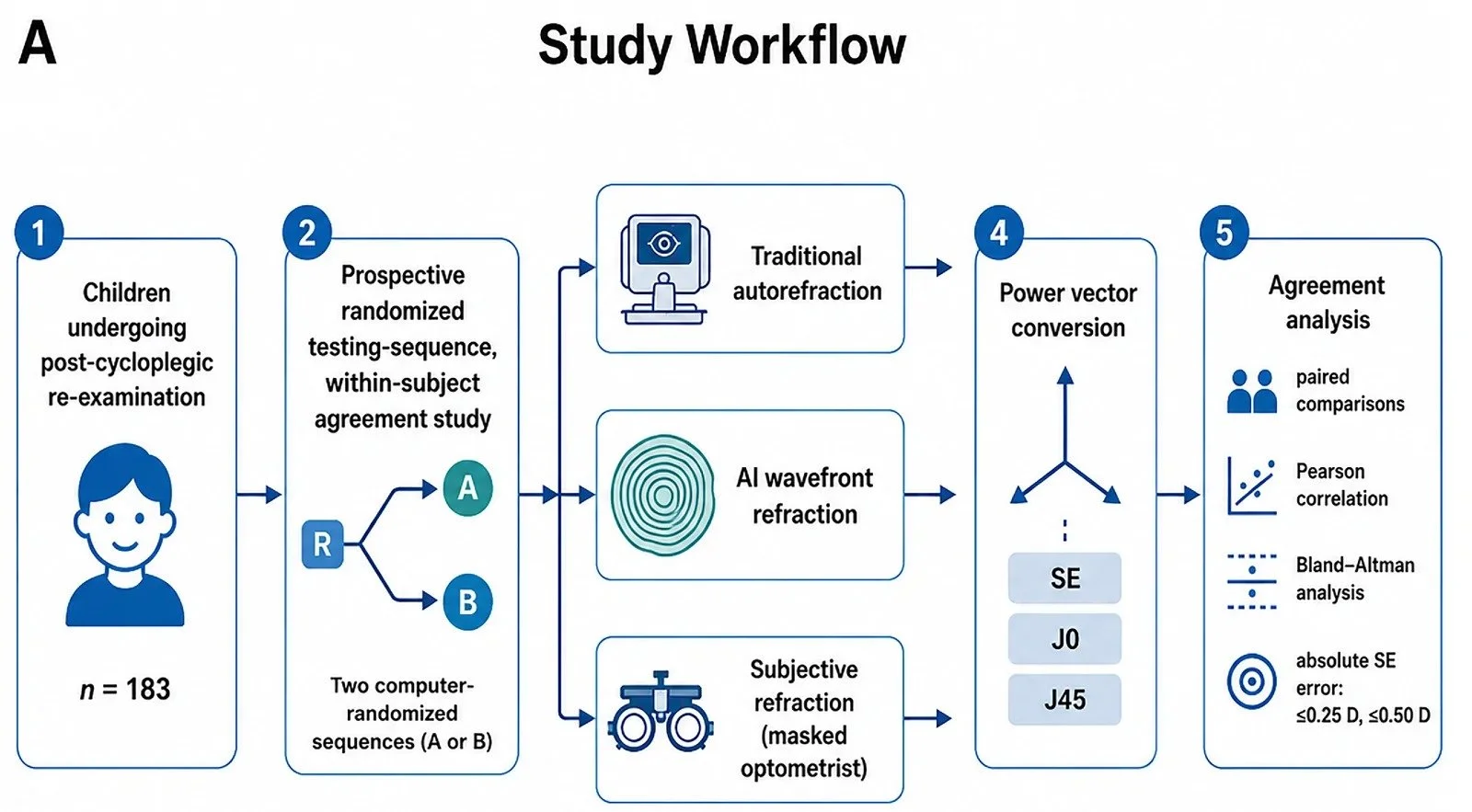
Figure 1 from Chang et al., Transl Vis Sci Technol 2026 (CC BY-NC-ND 4.0, unaltered): study workflow and the digital twin-inspired prescription pipeline. Source https://pmc.ncbi.nlm.nih.gov/articles/PMC13722964/figure/fig1/.
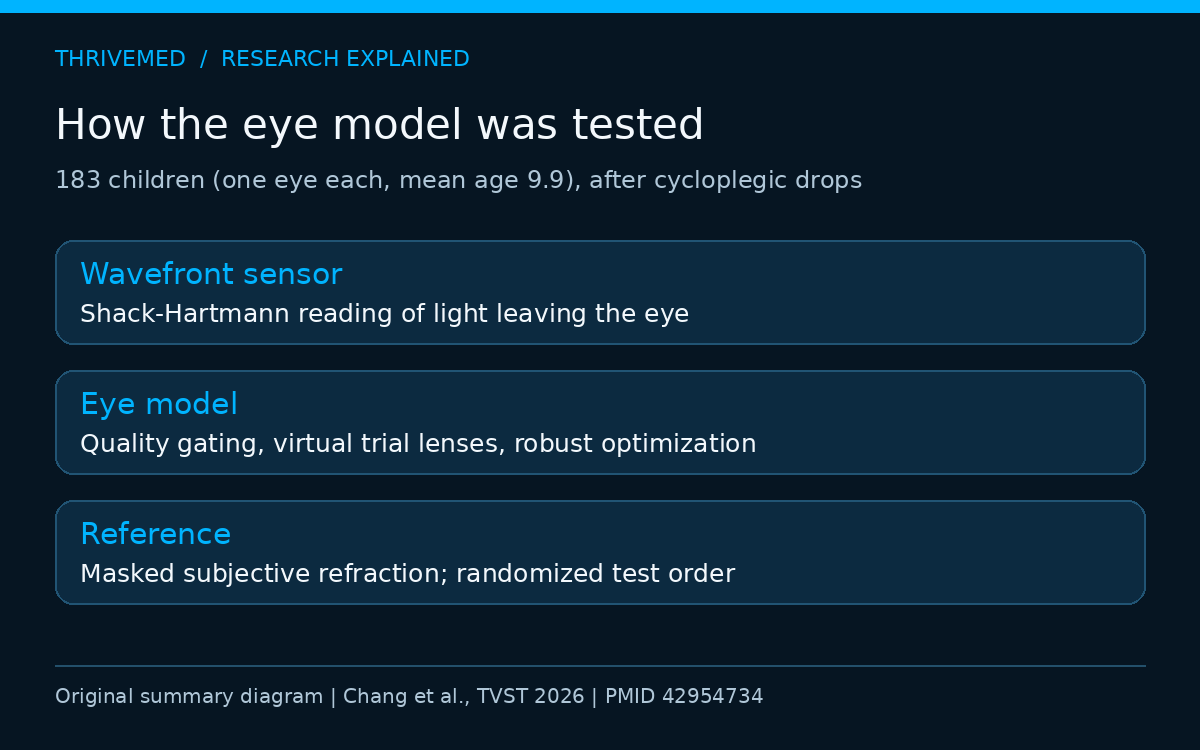
Original ThriveMed study-design diagram, derived from the paper.
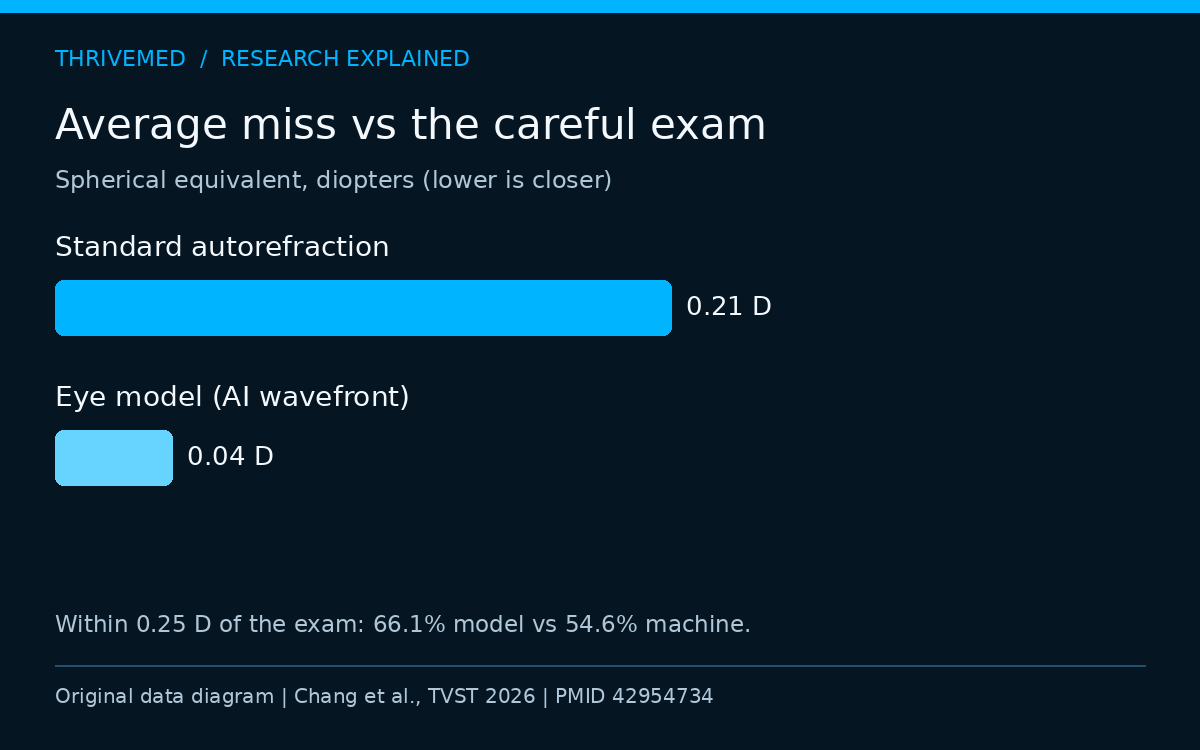
Original ThriveMed results diagram, numbers from the paper abstract.
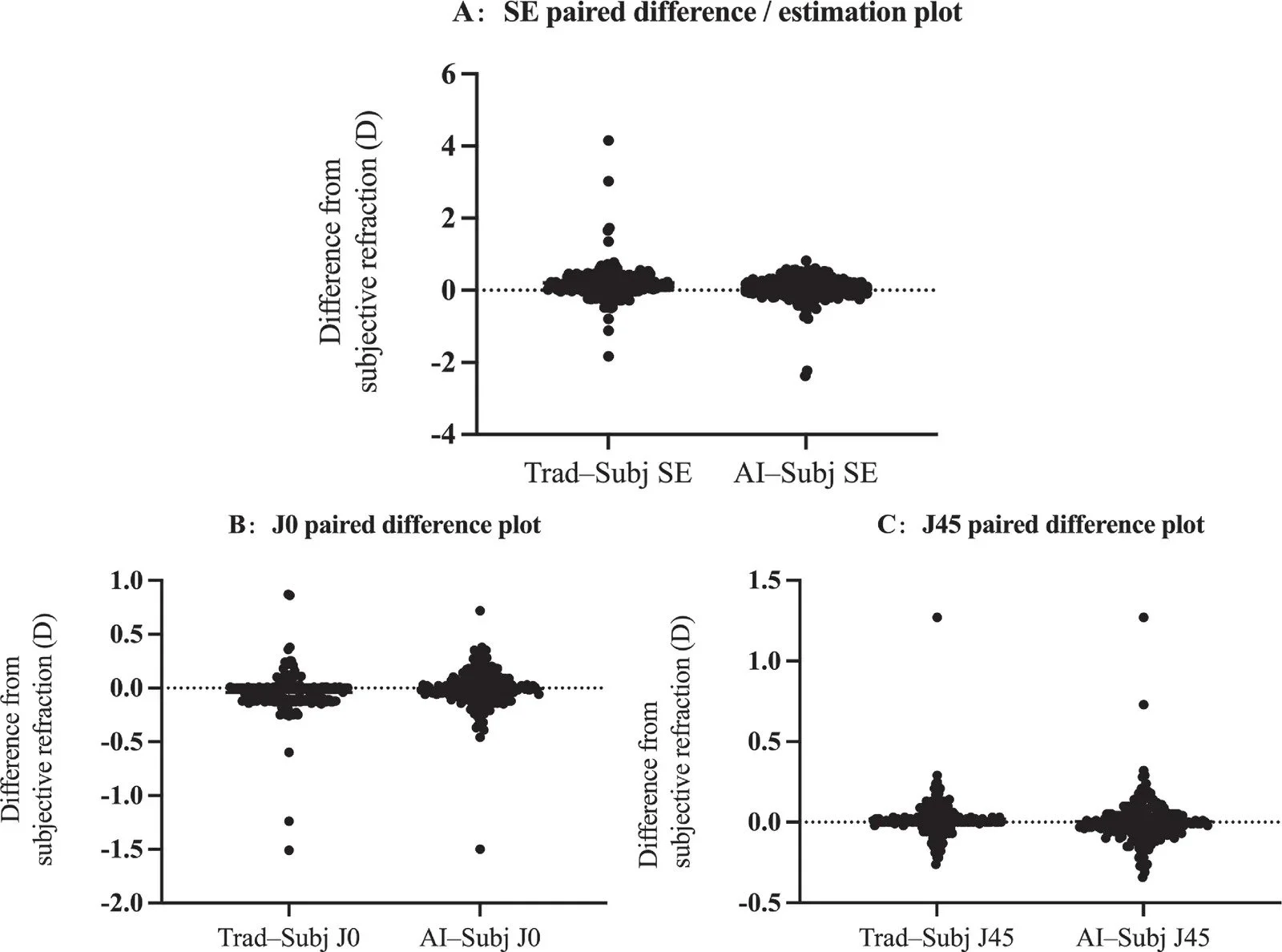
Figure 2 from Chang et al., Transl Vis Sci Technol 2026 (CC BY-NC-ND 4.0, unaltered): main agreement results for spherical equivalent and astigmatism, each method compared with masked subjective refraction. Source https://pmc.ncbi.nlm.nih.gov/articles/PMC13722964/figure/fig2/.