Every randomized trial asks a hard question of the families in it: will your child be in the group that gets the new treatment, or the group that does not? In neonatal medicine that question is heavier than anywhere else. A new paper in the Journal of Pediatrics tests an idea that could make it lighter. Instead of enrolling real babies as controls, could we build the control group from data, using "digital twins" drawn from a national registry?
The short answer from this study is a cautious yes, with clear limits. Here is what the team did, what they found, and what it means if your baby is ever offered a place in a trial.
Why control groups are so hard in the NICU
Babies born before 29 weeks are among the most fragile patients in any hospital. Premature birth brings risks to the lungs, the gut, the brain and the eyes, and much of the care in a neonatal intensive care unit is still being refined by research. The World Health Organization notes that complications of preterm birth are a leading cause of death in children under 5 worldwide.
To know whether a new treatment helps, researchers compare it with a control group. That comparison is the backbone of evidence-based medicine, and the MedlinePlus guide to clinical trials explains why randomization matters so much. But parents who enroll a very premature baby often hope for the active treatment. Some decline to take part at all. Slow enrollment delays answers that the next group of babies needs.
What a digital twin control arm is
A digital twin, in this setting, is not a simulation of a baby's body. It is a real infant from a large database who matches a trial participant on the features that matter most: how early they were born, their size, and the other entry criteria of the trial. If you can find a close match for every control baby, you might one day be able to compare a treated group against these matched records instead of a placebo group. I have covered other uses of the same idea, from a digital model of a child's eye to a digital twin of a sleep apnea waiting list, and the heart digital twin in precision cardiology.
What the study did
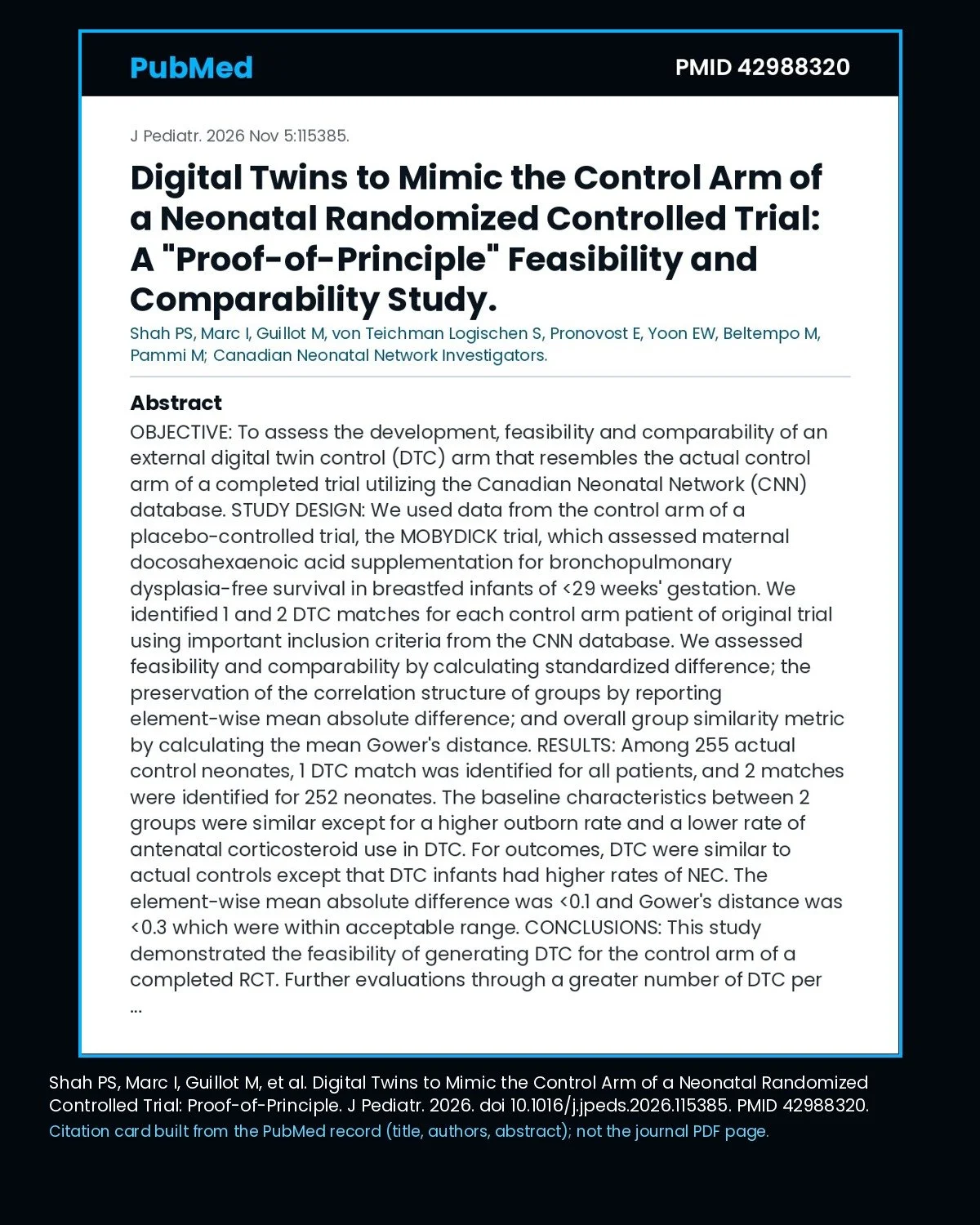
Shah and colleagues started from a trial that was already finished. MOBYDICK was a placebo-controlled trial of maternal docosahexaenoic acid (DHA), an omega-3 fat, given to mothers of breastfed infants born before 29 weeks. Its main outcome was survival free of bronchopulmonary dysplasia, the chronic lung disease of prematurity. If you want the background on these fats, the Cleveland Clinic has a clear page on omega-3 fatty acids.
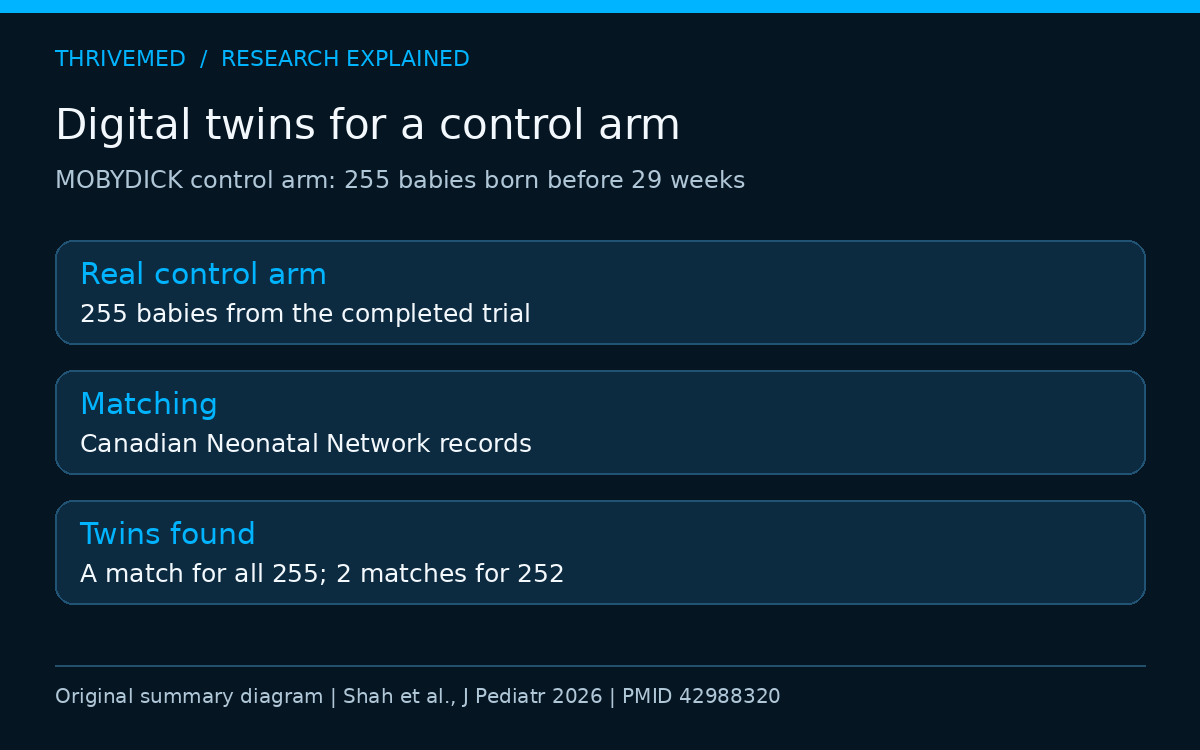
The team took the real control arm of MOBYDICK, the babies whose mothers received placebo. For each of those babies they searched the Canadian Neonatal Network database for one and then two matches, using the key inclusion criteria of the original trial. That set of matches became the digital twin control (DTC) arm.
They then asked three questions. Were the twins similar to the real controls at baseline? Did the twins preserve the way the variables related to each other? And how similar were the two groups overall? They used standardized differences, the element-wise mean absolute difference of the correlation structure, and the mean Gower's distance, a standard measure of how far apart two mixed sets of data are.
How close the twins came
The match rate was striking. Among 255 real control babies, the team found one twin for every single baby, and two twins for 252 of them.
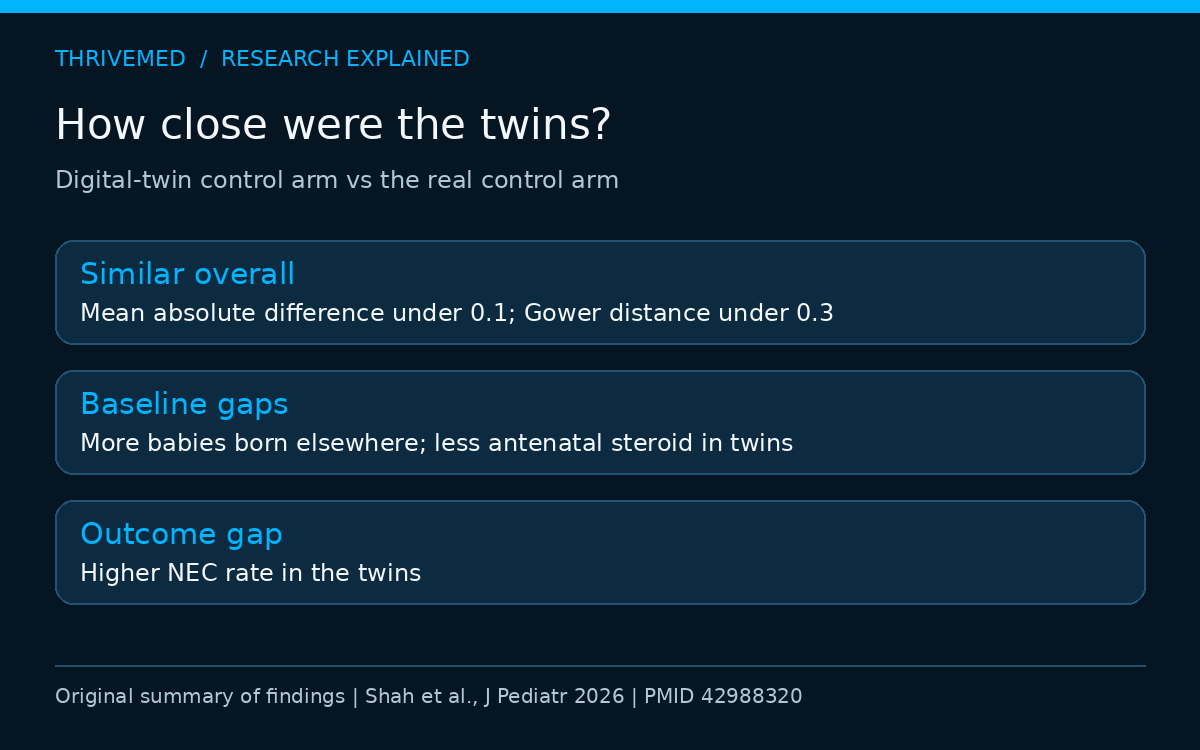
Most baseline features lined up. Two did not. The twins were more often outborn, meaning born at a hospital without a specialist unit and transferred afterwards, and their mothers less often received antenatal corticosteroids, the steroid shots given before an early birth to help a baby's lungs mature. You can read how these corticosteroids work in general terms.
Outcomes were similar too, with one exception: the twins had higher rates of necrotizing enterocolitis, or NEC, a serious bowel illness of premature babies. The overall similarity numbers were within the range the authors set as acceptable: the element-wise mean absolute difference was under 0.1 and Gower's distance was under 0.3.
What this does not prove
This was a look back at one completed trial. It shows that the twins can be found and that they resemble the real controls. It does not show that a future trial could safely replace its placebo group with twins.
The differences that remained matter. A baby born outside a specialist centre, or whose mother did not receive steroids, starts from a different place. A higher rate of NEC in the twin group would make a new treatment look better than it is if that treatment were compared against the twins. That is exactly the kind of bias a randomized control group protects against.
The authors are clear about the next steps. They want more twins per real control, testing in other completed trials, and choosing twins prospectively while a trial is running, rather than after it ends. Each of those would tell us whether the method holds up when it is used for real decisions.
What it means for families and clinicians
For families, the promise is real. If digital twin controls prove reliable, fewer babies might need to be randomized to placebo, and trials might enroll faster. That could bring answers sooner for conditions like lung disease and NEC. If you are a parent in the NICU, MedlinePlus on premature babies is a good plain-language starting point, and the NICHD preterm birth pages explain the research landscape.
For clinicians and researchers, the lesson is that a registry match is only as good as the variables it matches on. Outborn status and antenatal steroid exposure are known to shape outcomes. Any future design will need to match on them, or adjust for them, before twins can stand in for a randomized arm. The same caution applies to every "synthetic control" claim, a theme I come back to in my physician read on digital twins and blood sugar.
Two things you can use
- If your baby is offered a place in a trial, ask how the control group is chosen and what your baby's care would be compared against.
- When you read about "synthetic" or "digital twin" control arms, look for two things: how closely the twins matched, and which differences remained.
More of my evidence reads live on the Dr. Zuleta blog and in the Digital Twins series.
Sources
Shah PS et al. Digital Twins to Mimic the Control Arm of a Neonatal Randomized Controlled Trial. J Pediatr 2026. PubMed record. DOI 10.1016/j.jpeds.2026.115385. Elsevier, all rights reserved: citation card used, not the PDF page.
Comment and I'll send you the paper.