There is one lab number I never ignore when it comes back very high: triglycerides. Most people think of them as a heart number. At severe levels they are also a pancreas number, because very high triglycerides can trigger acute pancreatitis, one of the most painful emergencies in medicine. Two new trials in the New England Journal of Medicine, SHASTA-3 and SHASTA-4, tested a shot given once every three months to bring those levels down. They also asked the question patients care about most: does it prevent pancreatitis?
Why severe triglycerides matter
Triglycerides are the main form of fat carried in the blood. They rise after meals and are cleared by the body over the following hours. In some people, because of genes, diabetes, alcohol, certain medicines or a combination, clearance fails and the level climbs far above normal. The Cleveland Clinic has a good overview of what triglycerides are and how they are measured.
When levels get very high, the blood can become thick with fat particles, and the pancreas can become inflamed. Pancreatitis can mean days in hospital, and repeated attacks can damage the organ for good. MedlinePlus on pancreatitis describes the symptoms: severe upper belly pain that spreads to the back, nausea and vomiting. For people who have lived through an attack, the fear of the next one is real and constant.
What plozasiran is
Plozasiran is a small interfering RNA, a type of medicine that silences one specific gene message inside liver cells. Its target is APOC3, the messenger RNA for apolipoprotein C-III, a protein that slows the clearance of triglyceride-rich particles from the blood. Turn down APOC3, and the body clears those particles faster. It is the same logic of targeting the liver's instructions that I discussed in my physician take on the Kylo-11 Lp(a) study.
How the two trials were run
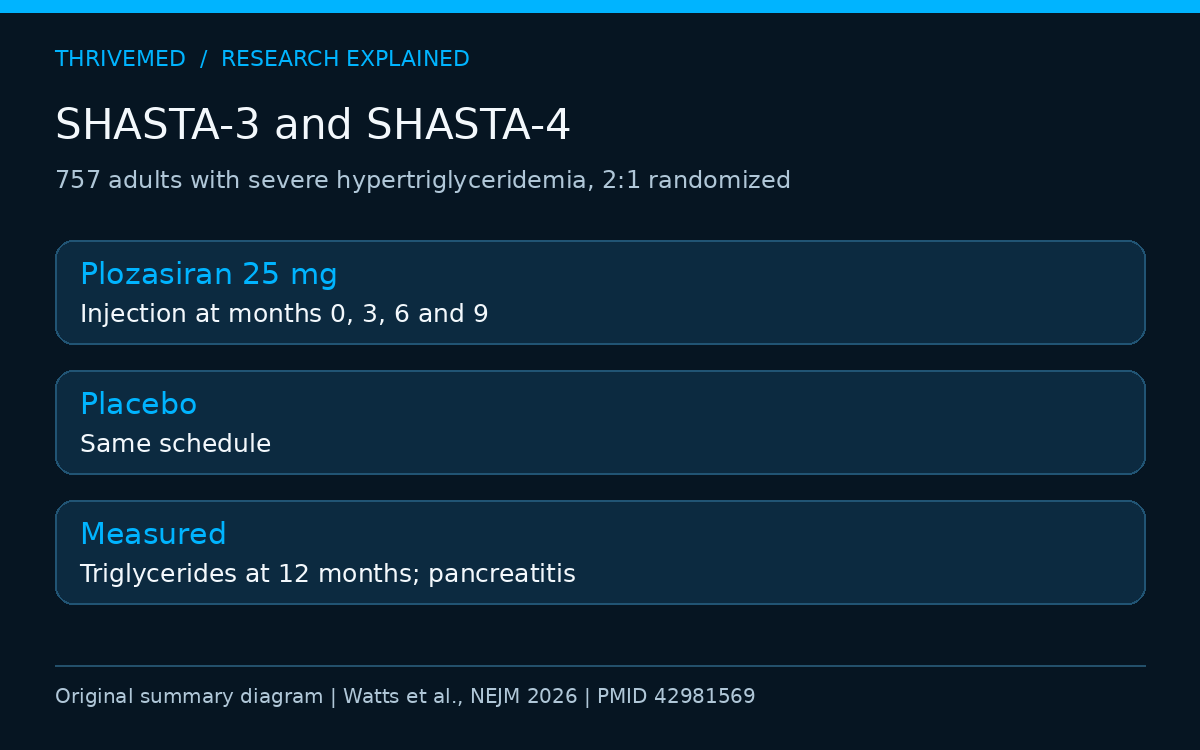
SHASTA-3 and SHASTA-4 had identical designs, end points and analysis plans, which lets the results be read side by side and pooled. In total, 757 adults with severe hypertriglyceridemia were randomly assigned in a 2:1 ratio to plozasiran 25 mg or placebo. The injections were given at baseline and then at months 3, 6 and 9, so four shots over the year. Both trials were double-blind, meaning neither patients nor investigators knew who received the drug. Both are registered: SHASTA-3 on ClinicalTrials.gov and SHASTA-4 on ClinicalTrials.gov.
The main question was the percent change in fasting triglycerides from baseline to month 12. A pooled analysis then looked at adjudicated acute pancreatitis, meaning each suspected case was reviewed by an independent committee rather than taken at face value.
What changed with treatment
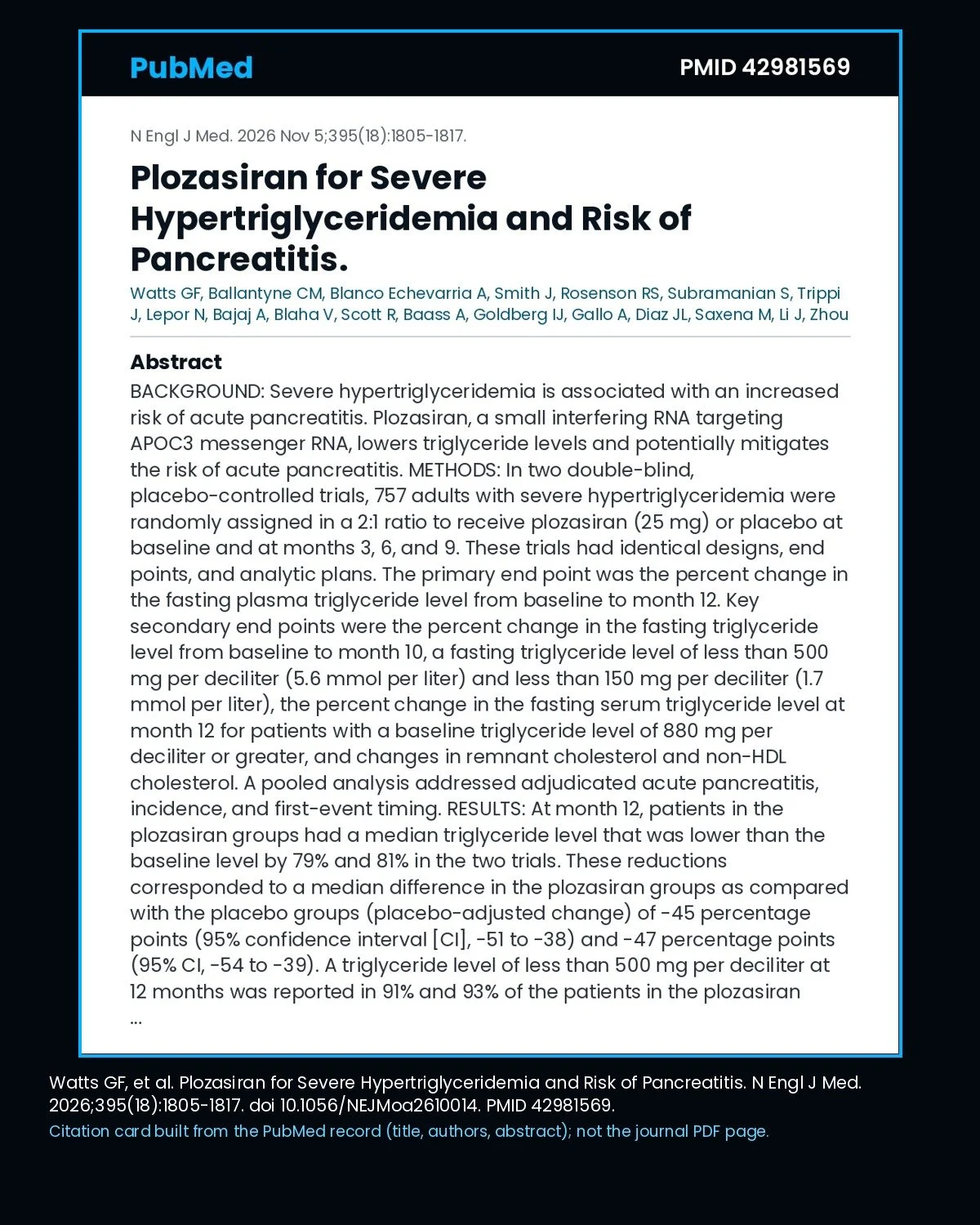
At month 12, median triglycerides were 79% lower than baseline in one trial and 81% lower in the other. After subtracting what happened on placebo, the differences were 45 and 47 percentage points. That is a large effect for a lipid drug.
Just as important is where people ended up. A level under 500 mg per deciliter is the line many clinicians use to judge pancreatitis risk. With plozasiran, 91% and 93% of patients were under that line at 12 months, compared with 51% and 50% on placebo.
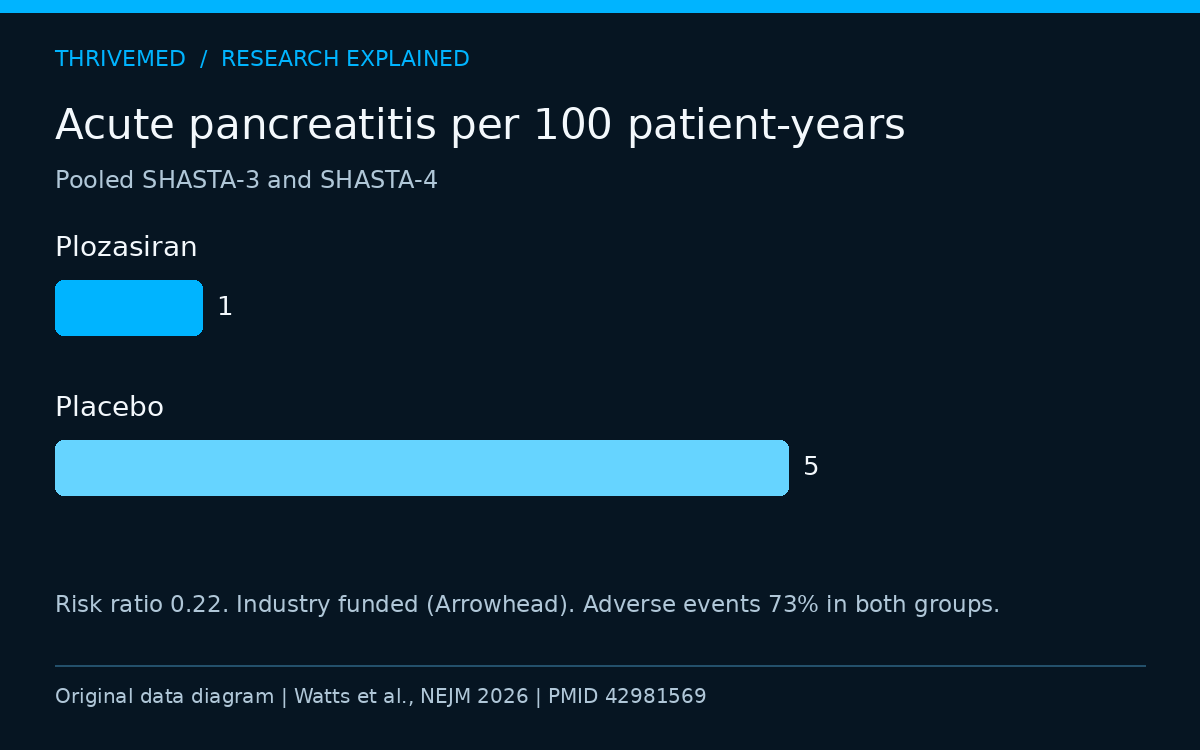
Then the outcome that matters most. In the pooled data, acute pancreatitis occurred at a rate of 1 per 100 patient-years with plozasiran and 5 per 100 patient-years with placebo, a rate ratio of 0.22 (P = 0.008). In plain terms, attacks were about a fifth as common on treatment.
Safety and the honest limits
Adverse events during treatment were reported in 73% of patients in both the plozasiran and placebo groups, which suggests no large excess of side effects over the year studied. Still, a year is a short window for a medicine that would likely be used for life. Longer follow-up will tell us about rare effects and whether the protection against pancreatitis holds.
The trials were funded by Arrowhead Pharmaceuticals, the developer of plozasiran. That is normal for drug trials, and the adjudicated design helps, but it is worth knowing. The trials also enrolled people with severe levels. These results do not tell us whether the drug helps people whose triglycerides are only mildly raised, or whether it lowers heart attacks.
Where this fits in everyday care
For most people with high triglycerides, the first steps remain the basics: treating diabetes, limiting alcohol, reviewing medicines that raise triglycerides, and changing diet. MedlinePlus has a practical guide on lowering cholesterol and triglycerides with diet, and the Cleveland Clinic explains the link between triglycerides and heart health.
For the smaller group whose levels stay severe despite all of that, and especially for people who have already had pancreatitis, a shot every three months that cuts attacks to about a fifth would change daily life. If that describes you, it is a conversation worth having now. I also explain why I look past the standard lipid panel in my deep read of the REACT study on silent plaque and in my short on why a calcium score of zero is not always zero plaque.
Questions to ask your doctor
- Are my triglycerides high enough to raise my pancreatitis risk, and what is driving them?
- Which causes can we fix first, such as blood sugar, alcohol or a medicine?
- If my levels stay severe, am I a candidate for newer APOC3-targeting treatments, and how would we track the effect?
You can find more of my evidence reads on the Dr. Zuleta blog and the ThriveMed take on the Lp(a) test and Kylo-11.
Sources
Watts GF et al. Plozasiran for Severe Hypertriglyceridemia and Risk of Pancreatitis (SHASTA-3 and SHASTA-4). N Engl J Med 2026;395(18):1805-1817. PubMed record. Funded by Arrowhead Pharmaceuticals.
Clip source in the Short: Peptide Breakthroughs Ep 22 (tesamorelin), Falutz J et al. NEJM 2007;357:2359-70, PMID 18057338.
Comment and I'll send you the paper.