More Than Half of Healthy Adults Had Silent Plaque: My Read of the REACT Study
By Andres Zuleta, MD

On August 29, 2026, the New England Journal of Medicine published REACT, a study that looked for atherosclerosis itself rather than estimating the odds of having it. It was presented the same day in a Hot Line session at ESC Congress 2026 in Munich. I have read the paper and the supplementary appendix. Here is what I think it shows, what it does not, and how I plan to use it.
If you want the practical, patient-friendly version, I wrote that for ThriveMed here: Hidden Artery Plaque: What the REACT Study Means for You.
The design
REACT enrolled 16,808 adults aged 18 to 70 in Denmark and Spain, all without known atherosclerotic cardiovascular disease. Enrollment was deliberately stratified into five age bands, with balanced numbers of women and men in each. The mean age was 45, and 51.4% were women.
Everyone was imaged in three territories:
Carotid arteries with 3D vascular ultrasound
Femoral arteries with 3D vascular ultrasound
Coronary arteries with coronary CT angiography plus a non-contrast calcium score
For the prevalence analysis, the investigators used the 13,186 people with complete imaging of all three territories.
What they found
Silent atherosclerosis was present in 57.1% of participants (95% CI 56.3 to 58.0). Prevalence was 63.4% in men and 50.9% in women.
By age band (Supplementary Table S7), men and women:
18 to 29: men 8.7%, women 6.7%
30 to 39: men 34.6%, women 21.3%
40 to 49: men 66.3%, women 47.6%
50 to 59: men 88.2%, women 74.8%
60 to 70: men 98.1%, women 91.9%
Source note: the 40 to 49 and 50 to 59 figures are from the NEJM supplementary appendix (Table S7); the other figures are also reported in the NEJM abstract, the ESC release and published coverage.
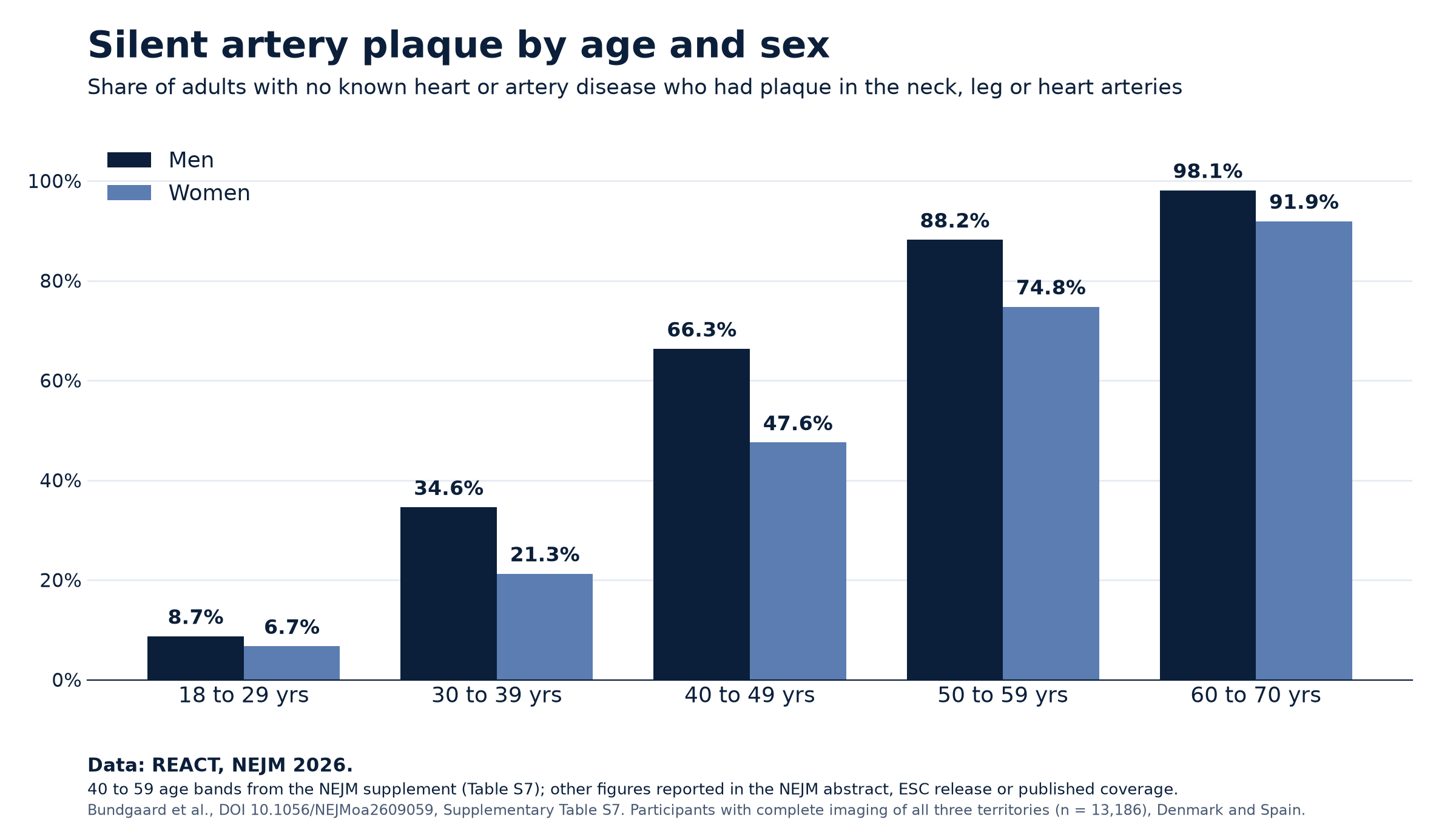
Chart rebuilt from the published numbers. Data: REACT, NEJM 2026.
Several findings matter clinically.
It starts early and in the periphery. In younger adults, plaque was usually in one territory, most often the carotid. Plaque only in the heart arteries was uncommon at every age: at most 9.3% of men and 5.0% of women. Of the people with coronary plaque, 82.0% also had neck or leg plaque, compared with 41.5% of those without coronary plaque. The authors note that carotid imaging gave the highest diagnostic yield.
Men lead, women catch up. Men showed an atherosclerotic trajectory 5 to 10 years earlier. Women had a later, steeper rise between 40 and 60, which broadly overlaps with the menopausal transition. This is an association in cross-sectional data, not proof that menopause causes it. By 60 to 70, all three territories were involved in 56.3% of men and 30.7% of women.
A calcium score of zero did not exclude coronary plaque in younger adults. Among 30 to 39 year olds who had coronary plaque on CT angiography, 41.8% of men and 48.4% of women had a calcium score of 0. In the authors' words, "calcium scoring alone does not exclude early coronary atherosclerosis." This deserves care. The 2026 ACC/AHA dyslipidemia guideline upgraded calcium scoring to a Class 1 recommendation for risk stratification and allows a score of zero to support deferring statins in selected low- or intermediate-risk adults (ACC summary). REACT does not contradict that guidance, which was built on outcome data. It reminds us what a zero does and does not mean anatomically, especially in younger patients.
Risk scores and imaging captured different people. A high SCORE2 category flagged only 0.5% of people with single-territory plaque and 3.8% of those with combined coronary and peripheral plaque. High SCORE2 was 99.8% specific but only 1.9% sensitive. Moderate-to-high SCORE2 was 87.9% specific and 34.1% sensitive. The mismatch was largest in younger adults. To be fair to SCORE2, it was built to predict 10-year events, not the presence of plaque, and it is not calibrated for people under 40 in Europe. Still, the practical point stands: a low 10-year risk does not mean an empty artery.
What REACT does not show
I want to be as clear about this as about the headline.
It is a snapshot. The baseline analysis is cross-sectional. The age curves compare different people at different ages; they do not track plaque growing in the same person.
There is no outcome data from REACT yet. We do not know which of these plaques would have caused an event.
It does not prove that treating the plaque it finds prevents events. That is the question for REACT's planned phase 2, a large randomized trial of imaging-guided prevention, which CNIC describes as planned for 2027 to 2032 if funded.
Routine imaging of young, symptom-free adults is not in current guidelines. US and European primary prevention is still built on risk tools, PREVENT and SCORE2.
The population was European. All participants were from Denmark and Spain. The team reports collaborations to validate the findings in India, Singapore, Tanzania and Mexico.
Funding. Funded by the Novo Nordisk Foundation.
Other limitations the authors list: stratified enrollment, so 57.1% is not a population-weighted estimate; incomplete three-territory imaging in some participants; and healthy-participant bias, which may mean the true prevalence is higher.
How I'm using it in practice
What follows is my own clinical inference, not a finding of the study.
A low risk score opens the conversation. It does not close it. That is especially true for younger adults with a family history or rising lipids, and for women heading into the menopausal transition.
I lean on the causal lipid markers. I check ApoB, which the ACC summary notes can help refine decisions about starting therapy in primary prevention. I also make sure Lp(a) has been measured at least once, which the 2026 ACC/AHA guideline now recommends for all adults. I wrote more about Lp(a) here: What Kylo-11 Means for Your Lp(a) Care.
I image when the result would change the plan. That might be carotid or femoral ultrasound, a calcium score, or CT angiography, depending on the question and the patient. I do not image just to have a picture.
I interpret a calcium score of zero with age in mind. In a younger patient with a strong risk profile, a zero is reassuring about calcified plaque, not proof of clean arteries.
This is what proactive clinical care means to me. It is a new way of doing healthcare that looks for disease directly, instead of waiting for it to announce itself, while staying honest about where the evidence ends.
Watch: the REACT study in 5 minutes
Watch on YouTube. Want the quickest version? Watch the 52-second Short.
FAQ
What is silent atherosclerosis?
Plaque in the artery walls that causes no symptoms and has not been diagnosed. In REACT it was defined by imaging of the carotid, femoral and coronary arteries.
How common was it in REACT?
57.1% of adults aged 18 to 70 without known cardiovascular disease, rising from about 1 in 13 at ages 18 to 29 to about 9 in 10 at ages 60 to 70.
Does a calcium score of zero mean I have no plaque?
Not necessarily, especially if you are younger. In REACT, 41.8% of men and 48.4% of women aged 30 to 39 who had coronary plaque had a calcium score of zero.
Should everyone get an artery scan?
Current guidelines do not recommend routine imaging for young adults without symptoms, and REACT has not yet shown that imaging-guided treatment prevents events. Ask whether a scan would change your plan.
Who funded REACT?
Funded by the Novo Nordisk Foundation.
Sources and further reading
Bundgaard H, et al. Prevalence of Silent Atherosclerosis across Adult Life. N Engl J Med. 2026. DOI 10.1056/NEJMoa2609059 (PubMed)
Follow along
YouTube: @andreszuletamd9789
Instagram: @andreszuletamd
LinkedIn: Andres Zuleta, MD
Patient guide on ThriveMed: Hidden Artery Plaque: What the REACT Study Means for You
This article is for education and is not medical advice. Talk with your own clinician about your situation.