One Shot, Nearly a Year of Lower Lp(a): My Honest Read of the Kylo-11 Lancet Study
By Andres Zuleta, MD · Physician perspective

When I sit down with a patient to go over a cholesterol panel, there is one number I almost always wish I had in front of me, and it is usually missing. It is not LDL. It is not triglycerides. It is lipoprotein(a), written Lp(a), and most of the people I meet have never been tested for it.
So when The Lancet published the first-in-human trial of a long-acting gene-silencing drug called Kylo-11 on August 28, 2026, I read it closely. This is my personal take as a physician: what excites me, where I pump the brakes, and what I think you should actually do with this news today.
Why I care about a number most panels skip
Lp(a) is a cholesterol-carrying particle made in the liver. I describe it to patients as LDL's genetically stickier cousin. It looks a lot like LDL, but its structure means that when it runs high, it can add to plaque buildup in artery walls and nudge the blood toward clotting. That is why cardiologists treat it as a heart disease and stroke risk marker.
Here is the part that frustrates me as a clinician. About 80 to 90% of your Lp(a) level is inherited. I can coach someone through a great diet, a real exercise plan, and better sleep, and their Lp(a) will barely move. Statins and lifestyle still matter a lot for the rest of the risk picture. They just are not a reliable dial for this particular number.
And there is still no approved drug built specifically to lower Lp(a). For years, the honest answer to "my Lp(a) is high, now what?" has been: we optimize everything else and keep watching.
What the Kylo-11 trial actually tested
Before I get excited about any headline, I want to know how the study was built. Here is the short version.
The design
Phase 1, first-in-human, randomised, double-blind, placebo-controlled trial
71 people enrolled in China; 70 received a single dose of Kylo-11 or placebo
One subcutaneous injection (a shot under the skin), then follow-up for about 48 weeks, roughly 11 months
Led by Ashish Sarraju, MD, a cardiologist at Cleveland Clinic, and colleagues; presented as a late-breaking trial at the European Society of Cardiology meeting in Munich
The full citation is at the bottom of this post, and you can read the paper through its DOI: doi.org/10.1016/S0140-6736(26)01484-4. The trial is registered as NCT06363851 on ClinicalTrials.gov.
The results, dose by dose
Across dose groups, one injection lowered Lp(a) by roughly 53 to 97% at 48 weeks. The highest doses produced reductions of about 95 to 97%, and that effect held for nearly a year.
What I find most useful is seeing the dose response laid out. From the published Phase 1 table, the median change in Lp(a) at about 48 weeks was:
Placebo: +6.6%
9 mg: -53.2%
30 mg: -77.6%
75 mg: -89.3%
225 mg: -94.6%
450 mg: -96.3%
600 mg: -97.0%
225 mg (Cohort 7, higher baseline Lp(a)): -95.6%
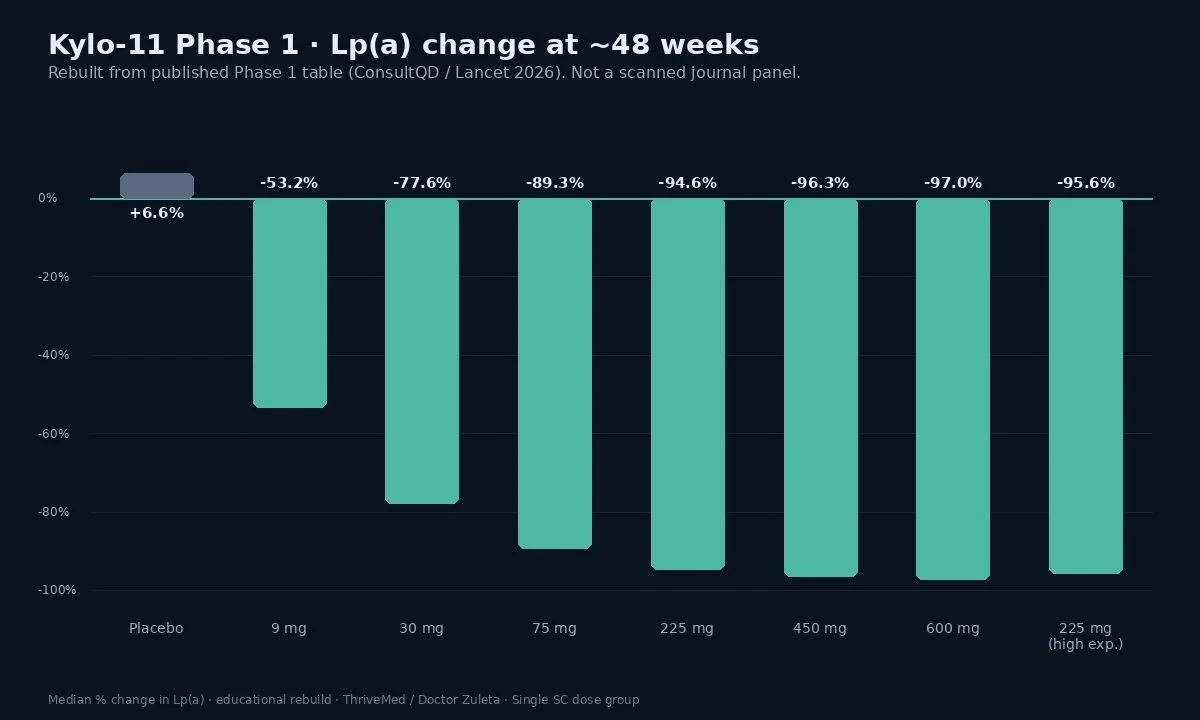
Kylo-11 Phase 1 dose response at about 48 weeks. Educational chart rebuilt from the published Phase 1 table (Sarraju et al., The Lancet, 2026). Not a scanned journal panel.
Doses of 225 mg and above were the durable ones, and the 600 mg group showed a median drop of about 97%. On safety, the drug was generally well tolerated, and no serious drug-related adverse events were reported in this trial.
How siRNA works, the way I explain it in clinic
Kylo-11 is a small interfering RNA, or siRNA. When patients ask me what that means, I use one picture: it is a mute button for the liver's Lp(a) factory.
Your liver builds Lp(a) using a protein called apo(a). Kylo-11 delivers a gene-silencing signal to liver cells that turns down production of apo(a). Less apo(a) means the body assembles far fewer Lp(a) particles. It does not change your genes. It turns down the volume on one set of instructions, and in this trial, a single shot kept that volume low for close to a year.
For the first time, an inherited risk marker got a year-long mute
This is the beat I keep coming back to. For the first time in humans, a single gene-silencing injection pushed Lp(a) down by as much as 95 to 97% and kept it there for nearly a year. Not a daily pill. Not a weekly shot. One dose.
For a risk factor that I was trained to think of as essentially untreatable, that is a genuine clinical advance. It also reflects a new way of clinical care that I believe in: measure the inherited risk early, then follow therapies designed to reach it directly.
This matters for the future because it could mean that people born with high Lp(a) eventually have a real option to modify a risk that no amount of lifestyle work can fix. If larger trials confirm that lowering Lp(a) this deeply actually prevents heart attacks and strokes, it could change how I approach lifelong heart disease prevention for those patients. That is a big if, and I want to be clear about it.
Where I pump the brakes
I am genuinely excited. I am also a physician, and overclaiming helps no one. Here is what this study does not tell us:
It is small and early. Phase 1 is designed to check safety and whether the drug moves the biomarker. Seventy dosed participants is a starting point, not a verdict.
It is not proven to reduce heart attacks or strokes. Lowering a number on a lab report is not the same as preventing events. That question needs cardiovascular outcome trials.
It is not FDA approved. Kylo-11 is investigational and not available for routine clinical use.
More data is coming. A Phase 2 trial is already underway, run by the sponsor, Kylonova Biopharma, with Dr. Sarraju and Cleveland Clinic.
Excitement is fair. Overclaiming is not. Turning this signal into fewer heart attacks is the next chapter, not this one.
What I am doing with this in my own practice
Nothing about Kylo-11 changes what I can prescribe today. What it changes is how strongly I push one simple step: get your Lp(a) measured. You cannot feel high Lp(a), and you cannot diet it away. For most people, one blood test, often once in a lifetime, tells you where you stand.
When a patient's Lp(a) comes back high, here is how I think about it:
Put it in context. Family history, LDL, blood pressure, blood sugar, smoking, and inflammation all shape the real risk.
Tighten everything else. Aggressive management of the risk factors we can treat is still the practical playbook.
Stay curious, not impatient. We revisit the plan as Phase 2 and Phase 3 data mature, without treating pipeline news as a prescription.
As Dr. Sarraju put it in the Cleveland Clinic announcement: "Most people with high Lp(a) don't know it." I would like to help change that.
If you want the care-focused version of this story, including how we approach the Lp(a) lab with patients, read my companion piece for ThriveMed: Should You Get an Lp(a) Test? What a New Lancet Study Means for Your Care.
Watch: the full breakdown
]
Watch on YouTube. Short on time? Watch the 45-second Short.
For more research decodes, subscribe on YouTube at Andres Zuleta, MD, follow me on Instagram at @andreszuletamd (the Kylo-11 Reel is up now), or connect with me on LinkedIn at Andres Zuleta, MD and join the conversation on my LinkedIn post about this study. The full study one-pager, with figures, lives here: Kylo-11 study one-pager.
Frequently asked questions
What is Kylo-11?
Kylo-11 is an investigational, long-acting small interfering RNA (siRNA) drug designed to lower lipoprotein(a). It works in the liver by turning down production of apo(a), a building block of Lp(a). It is not FDA approved.
How much did Kylo-11 lower Lp(a) in the Lancet study?
In the Phase 1 trial published in The Lancet on August 28, 2026, a single injection lowered Lp(a) by roughly 53 to 97% at 48 weeks, depending on dose. The highest doses produced reductions of about 95 to 97% that lasted nearly a year.
Does Kylo-11 prevent heart attacks or strokes?
We do not know yet. This was a small, early Phase 1 study focused on safety and Lp(a) levels. It did not test whether the drug reduces heart attacks, strokes, or deaths. That requires larger outcome trials.
Can diet or exercise lower my Lp(a)?
Not meaningfully. About 80 to 90% of your Lp(a) level is inherited. Healthy habits and treatments like statins still matter for your overall heart disease risk, but they are not a reliable way to lower Lp(a) itself.
Should I get an Lp(a) test now, even though Kylo-11 is not available?
In my view, yes, worth asking about. Knowing your number helps your clinician understand your overall risk and decide how aggressively to manage the factors you can change today. For most people it is a once-in-a-lifetime lab.
Sources
Sarraju A, Du X, Zhou L, et al. Safety and lipoprotein(a)-lowering effects of Kylo-11: a first-in-human, randomised, double-blind, placebo-controlled, phase 1 trial. The Lancet. Online Aug 28, 2026; 408(10558):899-909. DOI: 10.1016/S0140-6736(26)01484-4. PMID 42664979. ClinicalTrials.gov NCT06363851.
Cleveland Clinic Newsroom. First in Human Long-Acting Gene Silencing Therapy Significantly Lowers Heart Disease Risk Marker with One Injection. Aug 28, 2026.
National Heart, Lung, and Blood Institute (NIH). Lipoprotein(a): What to know about elevated levels.
American Heart Association. Lipoprotein(a).
Educational content from Andres Zuleta, MD. Not medical advice. Please discuss testing and treatment decisions with your own clinician.
Stay curious. Be proactive.