A stronger grip has been tied to lower odds of erectile dysfunction. It is the kind of line that spreads fast on social media, so I went to the peer-reviewed paper behind it. The paper is a review in Sexual Medicine Reviews by Duan and colleagues at Baylor College of Medicine, and what it found is more interesting, and more careful, than the headline.
Why muscle and sexual health might be linked
Erectile dysfunction is common, and it becomes more common with age, diabetes, heart disease and obesity. An erection depends on healthy blood vessels, healthy nerves, hormones and a healthy metabolism. MedlinePlus on erectile dysfunction lists the usual causes, and many of them are the same conditions that erode muscle.
Skeletal muscle is more than strength. It is the body's largest store for blood sugar, and it shapes how the body handles insulin and fat. Loss of muscle with age, called sarcopenia, travels with poor metabolic health. So a link between muscle and erectile function is biologically plausible. The question is how strong the evidence is.
What the review did
The team searched PubMed using terms for skeletal muscle and sexual dysfunction, along with keywords like sarcopenia, muscle mass, hand strength, resistance training and erectile function. The search returned 355 results, and 32 studies were included in the review.
Those studies used several ways of measuring muscle: muscle volume on scans, hand-grip strength and bioelectrical impedance, a simple test that estimates body composition. They compared these with erectile function, sexual desire and overall sexual satisfaction.
What it found
Across the included studies, muscle mass and strength tracked with sexual function, particularly in older men and men with sarcopenia, diabetes or obesity. The authors argue that muscle contributes through metabolic and endothelial mechanisms, meaning through how the body handles energy and through the health of the lining of blood vessels. Erections depend on both.
The headline number comes from older men. Each 5 kg of hand-grip strength came with lower odds of erectile dysfunction, with an odds ratio of 0.86 (95% CI 0.78 to 0.96). Put simply, each step up in grip came with somewhat lower odds. Odds are not the same as risk, and a population number is not a promise for any one man.
The second finding is the one I find most useful. Testosterone affects both muscle and blood vessels, so you might expect it to explain the whole link. It did not. The link between grip strength and the IIEF-5, a standard five-question erectile function score, held after adjusting for blood testosterone (β = .169, P = .037). In other words, the muscle signal is there even after accounting for hormones.
Why would grip matter? Grip strength is easy to measure with a handheld dynamometer, and in research it works as a stand-in for whole-body strength. It reflects muscle quality, nerve function and general fitness at once. That makes it a useful window on overall health, which is exactly why it keeps showing up in studies of aging, heart disease and now sexual function. It is not that the hand itself matters. It is what a strong hand tends to say about the rest of the body.
What it does not prove
Most of the included studies were cross-sectional. They took one snapshot of muscle and sexual function at the same time. A snapshot can show a link. It cannot show that one causes the other, or which comes first. Men who are healthier overall may simply be both stronger and have better erectile function.
The review also brings together studies with different methods and populations, so the numbers should be read as a direction rather than a precise estimate. The authors themselves call for longer studies that follow men over time and test therapies. They mention that treatments aimed at both muscle and sexual function, such as testosterone and L-carnitine, may help, but that is a hypothesis to test, not a finding of this review.
What I take from it as a physician
The potential here is real, and it fits what many of my patients notice: when they get stronger and fitter, they feel better in every part of their lives, including sex. Building and keeping muscle is one of the best-supported things you can do for health with age. MedlinePlus on exercise for older adults and the benefits of exercise are good starting points.
The same theme runs through other research I have covered. In the T-REx trial, people on tirzepatide who lifted weights kept their strength, as I explain in my short on tirzepatide and lifting. And in a large analysis of semaglutide by frailty, the frailest patients still did well, which I cover in my physician read on semaglutide and frailty.
If testosterone is part of your conversation, the Cleveland Clinic page on low testosterone is balanced and clear. This review suggests muscle matters on top of hormones, not instead of them.
Two things you can use
- Grip strength is a simple marker of muscle and overall health. It is worth tracking as you age, with your doctor.
- If you are treating erectile dysfunction, ask what else is being checked: blood vessels, blood sugar, medicines and hormones, not grip alone. Erectile problems can be an early sign of blood vessel disease, so they deserve a full look.
For more on muscle, aging and peptides, see my video on ipamorelin's biggest human trial, the ThriveMed read on semaglutide and frailty, and the rest of the Dr. Zuleta blog.
Sources
Duan M, Hernandez B, Kronstedt S, Donato J, Saffati G, Parikh N, Khera M, Lyon G. Exploring the link between muscle quality and erectile dysfunction: assessing the impact of mass and strength. Sex Med Rev 2025;13(4):643-651. PubMed record. DOI 10.1093/sxmrev/qeaf033.
Comment and I'll send you the paper.
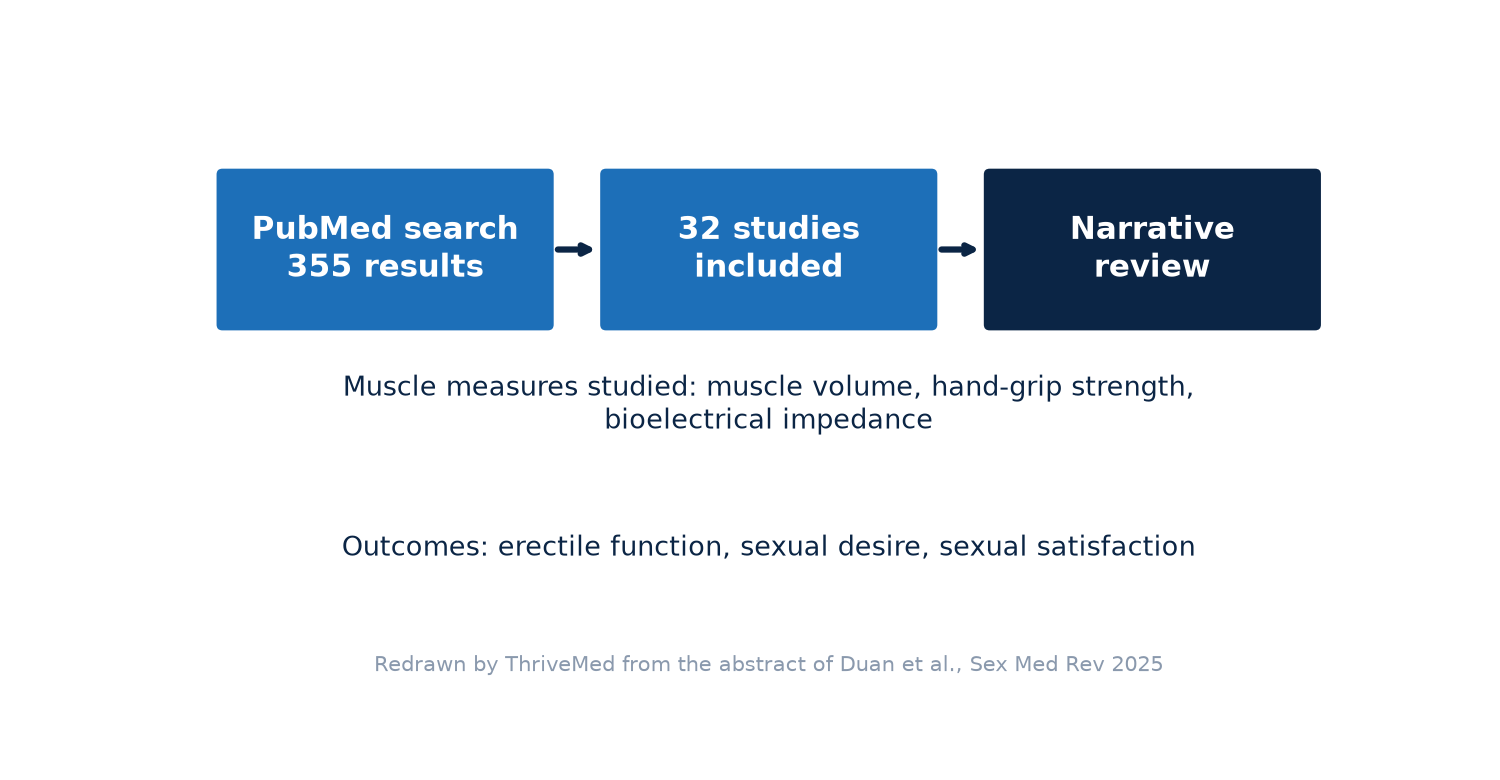
Redrawn by ThriveMed from the abstract of Duan et al., Sex Med Rev 2025: how the review was built (not a figure from the paper; the article is not open access).
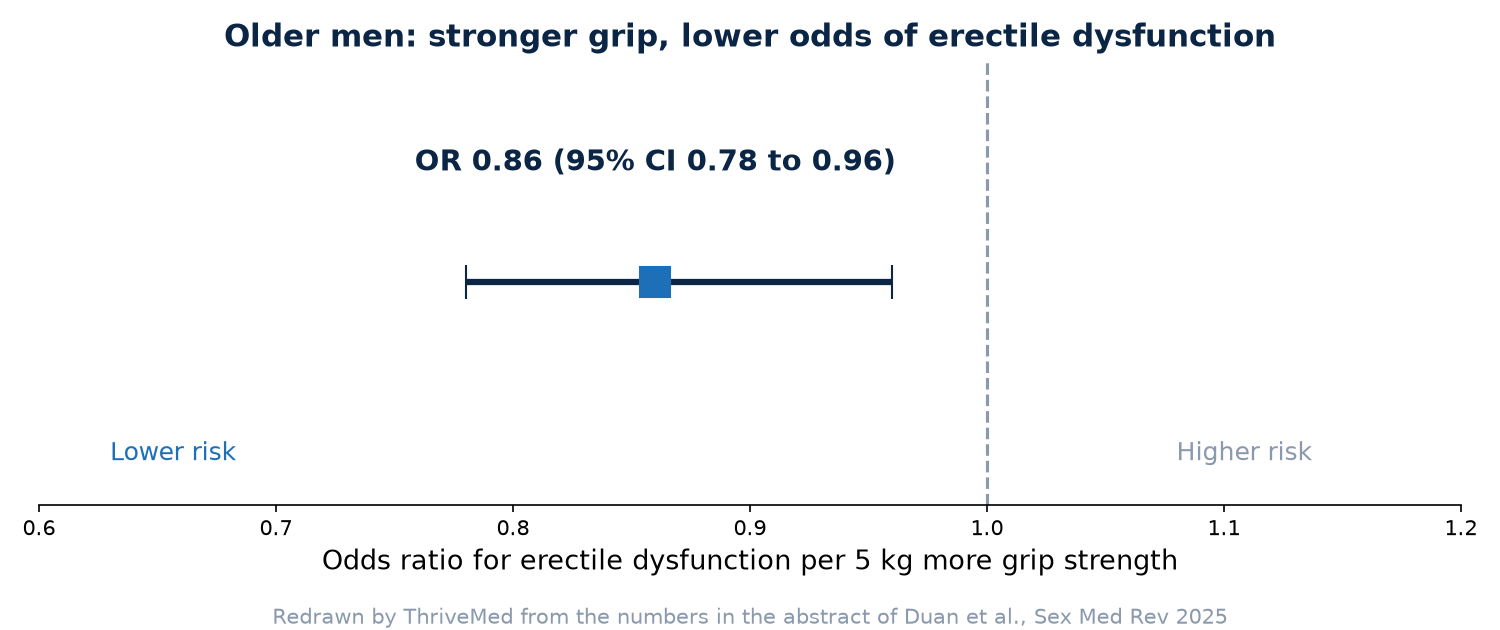
Redrawn by ThriveMed from the numbers in the abstract of Duan et al., Sex Med Rev 2025: grip strength and odds of erectile dysfunction in older men (not a figure from the paper).