Melflufen in Glioblastoma: A Physician's Read on the INSULA Window of Opportunity Data
Andres Zuleta, MD · A physician's read
When a press release says "major breakthrough" about glioblastoma, I read it twice: once for what was measured, and once for what was not. Here is my short read of the first INSULA data from Oncopeptides, released October 9, 2026.
The 5-minute read.
What was actually reported
INSULA (OP-701) is an open label, single site Phase 1 study at Oslo University Hospital, registered in the EU trials register as CTIS 2026-525543-32-00, with about 10 patients planned. Adults with recurrent glioblastoma already scheduled for resection get one 30 minute infusion of melflufen, either 30 minutes to 4 hours or 18 to 24 hours before surgery, and the resected tissue is analyzed.
In the first three patients, the company reports "clear and consistent presence of active compound" in tumor tissue, the primary endpoint of this part, at levels "in line with" preclinical work. Tolerability so far is described as good, with no major drug related toxicity and no unexpected surgical complications; one patient has received five monthly doses in an open label extension.
Three things I take from it
1. The design is right for the question. A window of opportunity study measures delivery where it matters, in the tumor, using tissue that is removed anyway. For a field where most drugs never reach the target, that is a sensible first gate.
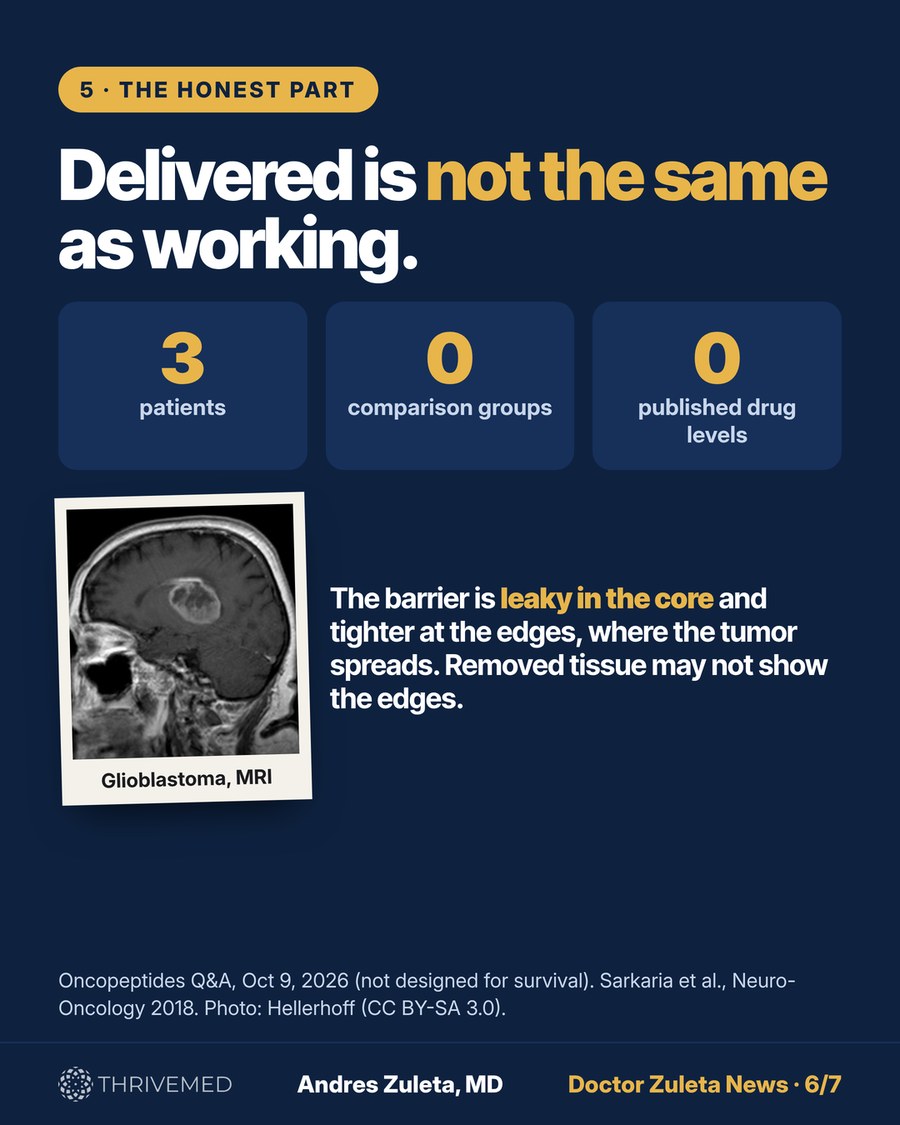
2. The data are thin on purpose, and also thin by omission. Three patients and no comparison group is expected at this stage. What is missing is less expected: no tissue concentrations, no plasma to tissue ratios, no split by timing arm, and no definition of "active compound", whether intact melflufen, released melphalan, or both. I would want those before drawing conclusions.
3. Where the tissue comes from matters. The blood-brain barrier in glioblastoma is heterogeneous: often disrupted in the contrast enhancing core, largely intact at the infiltrative margin (Sarkaria et al., Neuro-Oncology, 2018). Resected tissue tends to come from the enhancing core, so it may overstate delivery to the cells that drive recurrence. Prior surgery and radiation also change the barrier.
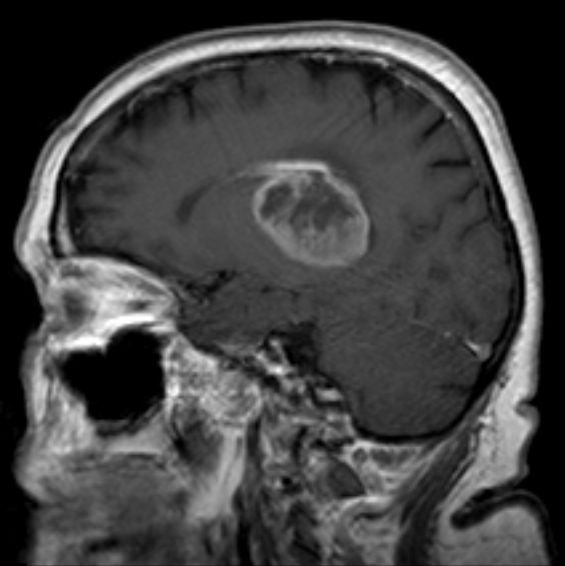
Contrast enhancement marks where the barrier leaks (image: Hellerhoff, Wikimedia Commons, CC BY-SA 3.0).
Context for the drug
Melflufen is a lipophilic peptide drug conjugate; esterases and peptidases release melphalan inside cells (EMA SmPC). It is authorised in the EU as Pepaxti for triple class refractory multiple myeloma after at least three prior lines, with a positive CHMP opinion for third line in September 2026 and the Commission decision pending. In the US, its 2021 accelerated approval was withdrawn in 2024 after OCEAN missed its primary endpoint and showed shorter median overall survival than the comparator. Myelosuppression is the main toxicity. It is not approved for any CNS tumor, and in INSULA it is used as a probe for the platform. It is also not the first peptide conjugate tried in brain tumors; ANG1005 came before.
What would change my mind
Published tissue and plasma levels by timing arm, sampling sites relative to the enhancing margin, and then a study with response or survival endpoints. Until then, this is a delivery signal, not an efficacy signal. The company's own Q&A says as much.
For the patient friendly version, see https://www.thrivemed.us/thrivecityblog/oncopeptides-glioblastoma-melflufen-blood-brain-barrier-physician-read.
Sources: Oncopeptides press release and Q&A, Oct 9, 2026; CTIS 2026-525543-32-00; Oslo University Hospital study page; EMA EPAR Pepaxti (SmPC 5.1) and CHMP opinion, Sep 17, 2026; Federal Register 2024-08274; Stupp R et al., N Engl J Med 2005; Pardridge WM, NeuroRx 2005; Sarkaria JN et al., Neuro-Oncology 2018; Parang K et al., Drug Des Devel Ther 2026.
Educational only, not medical advice. Andres Zuleta, MD.