Every protein medicine you have ever heard of, from insulin to semaglutide, rests on one idea: a protein is a chain of building blocks in a fixed order, and the order can be read. Someone had to prove that first. That someone was Fred Sanger, and the protein was insulin. The final step was a paper on the disulphide bonds of insulin in the Biochemical Journal. This post looks at what that paper finished, what it proved, and how far the idea has travelled since.
The first protein anyone could read
Proteins are chains of amino acids. The order is the meaning. Think of the words tea, eat and ate: the same letters, three different words. Swap the order of amino acids and you get a different protein with a different job, or no job at all. MedlinePlus explains this well in its genetics guide to what proteins are and what they do.
Before Sanger, many scientists doubted proteins had one exact order. Some thought they were loose mixtures, a little different from molecule to molecule. Insulin was the obvious test case. It was small, it was available in pure form, and it was already saving lives, a story I tell in my physician read on insulin in 1922.
What the 1955 paper finished
Sanger's group had already worked out the order of insulin's two chains. What remained was how the chains were tied together. In the 1955 Biochemical Journal paper, Ryle, Sanger, Smith and Kitai placed the three disulphide bonds, the sulfur bridges that hold insulin's shape. With them in place, insulin became the first protein whose complete structure, at the level of its sequence, was known.
The Nobel Prize summary for 1958 records that Sanger received the Chemistry prize for his work on the structure of proteins, especially insulin. The Cleveland Clinic overview of proteins gives a sense of why this mattered: proteins do most of the work in every cell, and you cannot understand a machine without knowing its parts.
What it took, and what it proved
In his 1958 Nobel lecture on the chemistry of insulin, Sanger described insulin as 51 amino acids in two chains, one of 21 and one of 30, and said the work took about 12 years, done by hand with paper strips and dyes. He also made the point that changed biology: each position in the chain is occupied by one and only one amino acid.
That single sentence is the foundation of modern medicine's protein era. If the order is fixed, it can be written down, compared between species, copied in a lab and eventually made in bacteria. Every step that followed depended on it. Cow, pig and human insulin turned out to differ at only a few positions, which explained why animal insulin worked in people at all, and why some patients reacted to it. Decades later, knowing the exact human sequence is what allowed bacteria to be programmed to make it. Read the full arc on my blog: Sanger's insulin sequence, the bead that let chemists build peptides in the Merrifield solid phase synthesis story, and the ThriveMed post on when bacteria started making human insulin.
The count today
The same idea now runs on machines instead of paper and dye. UniProt is the main open database of protein sequences. Its Swiss-Prot release statistics for release 2026_04 of November 4, 2026, which I queried on November 13, 2026, list 576,073 expert-reviewed protein sequences, including 20,429 human ones.
That second number is worth a pause. Roughly twenty thousand human proteins, each one a fixed chain that someone can now look up in seconds. Sanger needed about twelve years for one. Today the hard questions have moved on: what shape each protein folds into, how it interacts with others, and how we can design new ones. I touch on that frontier in the ThriveMed post on the AI that learned the language of life.
What it does not tell you
Knowing the order is not the same as knowing the three-dimensional shape. It also does not tell you how the body makes insulin from its precursor, or how insulin works on cells. The 1955 paper solved the sequence and its bridges, not those later questions. Those took decades more, and new tools, from X-ray crystallography to the AI models that now predict protein folds.
It is also worth saying what the database count does not mean. Reviewed entries are those checked by curators. Many more sequences exist in the unreviewed section, and counts change with every release as entries are added, merged or revised.
Why this matters for patients
When someone sells you a peptide or a protein product, the sequence is its identity. A real medicine has a published, exact sequence, made and tested to a standard. That is the practical legacy of Sanger's work, and it is a useful filter in a market full of claims. The National Human Genome Research Institute glossary entry on proteins is a good short refresher if you want the basics.
Two things you can use
- If something is sold to you as a peptide or a protein medicine, ask for the exact, published sequence. A real one has one.
- When you hear a big number of "proteins we have read," ask which database and which release. Counts change as entries are added or revised.
More history of peptide medicine lives in my Peptide Breakthroughs collection.
Sources
Ryle AP, Sanger F, Smith LF, Kitai R. The disulphide bonds of insulin. Biochem J 1955;60(4):541-556. PubMed record. Full text on PMC. DOI 10.1042/bj0600541 (primary).
Sanger F. The chemistry of insulin. Nobel lecture, December 11, 1958.
Nobel Prize in Chemistry 1958, Frederick Sanger.
UniProtKB/Swiss-Prot release 2026_04 (November 4, 2026), queried November 13, 2026: reviewed entries 576,073; human (organism_id 9606) 20,429. UniProt release statistics.
Comment and I'll send you the paper.
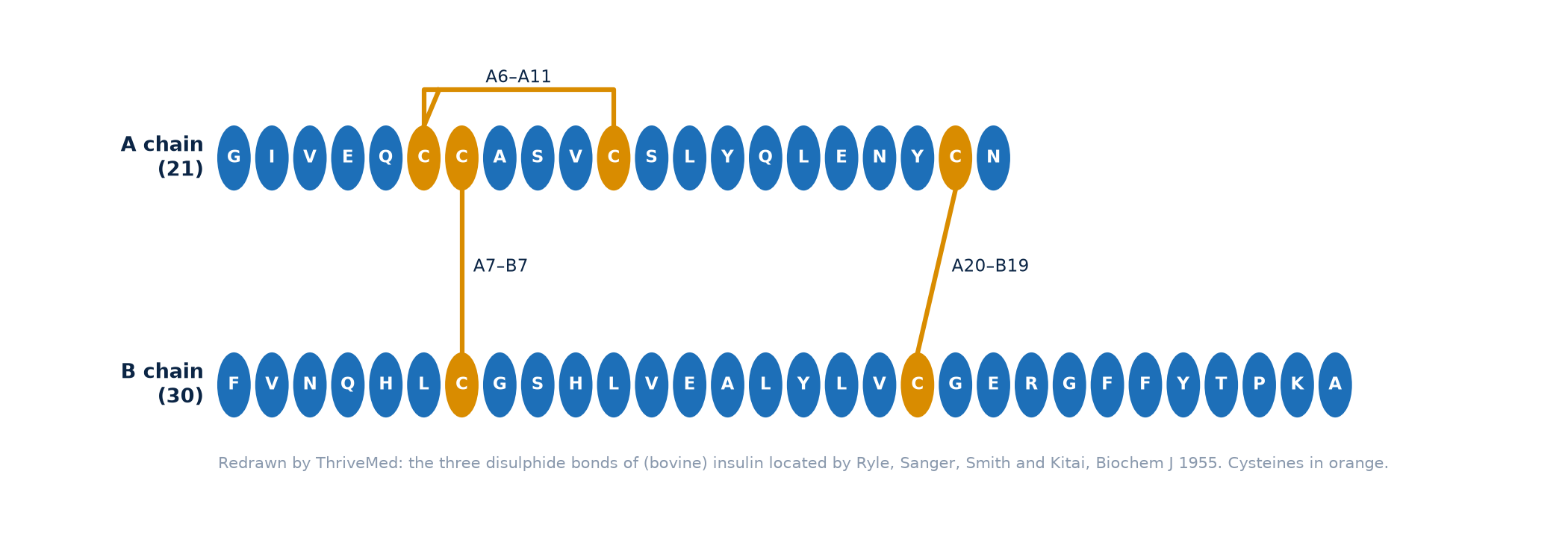
Redrawn by ThriveMed: the three disulphide bonds of insulin located by Ryle, Sanger, Smith and Kitai, Biochem J 1955 (schematic, not a figure from the paper).
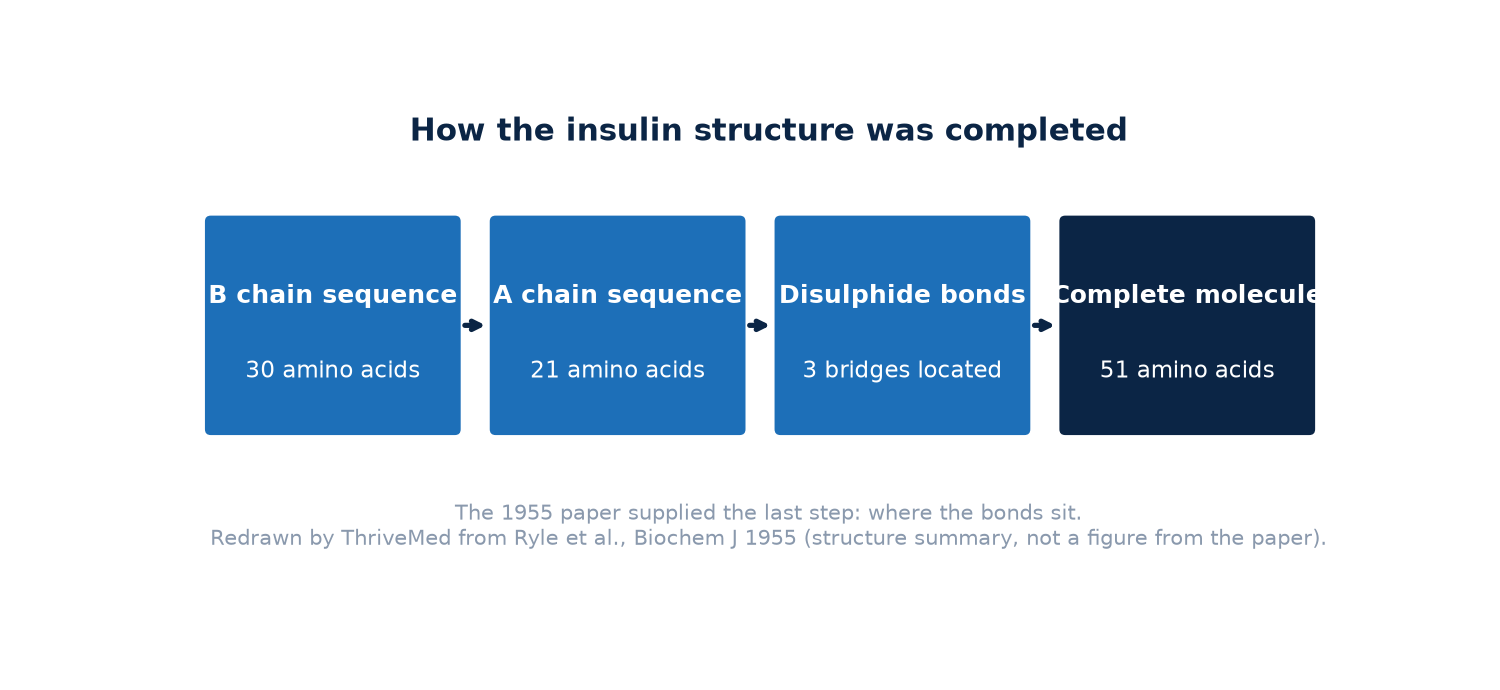
Redrawn by ThriveMed: the steps that completed the insulin structure, with the 1955 paper supplying the bond positions (summary, not a figure from the paper).