Recombinant Human Insulin, 1972 to 1982: A Physician’s Read on Boyer, Cohen and Genentech
By Andres Zuleta, MD · Prefer the patient version? Read it on the ThriveMed blog
When I prescribe insulin, the vial says nothing about pancreas glands or slaughterhouses. Before 1982 that was the supply chain: Genentech's history puts it at 8,000 pounds of pancreas from about 23,500 animals for one pound of insulin.
The 5-minute story.
The question
Animal insulin worked, and pig insulin differs from human insulin at a single position (cattle at three; Sanger's sequence, Episode 4). The question in the 1970s was whether a human peptide could be made directly, from a gene, in a host that copies itself.
What the record shows
- The vector, 1973: Cohen, Chang, Boyer and Helling (PNAS, November 1973) built "biologically functional bacterial plasmids in vitro": DNA cut with Boyer's restriction enzyme, rejoined, and carried and replicated by E. coli. Cohen later dated the plan to a November 1972 meeting in Honolulu, sketched on napkins.
- The safety pause, 1975: at Asilomar, scientists recommended the guidelines that NIH would issue.
- Proof of principle, 1977: Itakura, Hirose, Crea, Riggs, Heyneker, Bolivar and Boyer (Science, December 9, 1977) expressed a chemically synthesized gene for somatostatin, 14 amino acids, fused to beta-galactosidase on pBR322, and released the active peptide with cyanogen bromide: "the first synthesis of a functional polypeptide product from a gene of chemically synthesized origin."
- Insulin, 1978 to 1979: Crea, Kraszewski, Hirose and Itakura (PNAS, December 1978) synthesized the A chain (77 base pairs) and B chain (104) genes from 29 oligonucleotides, designed from the human sequence. Goeddel et al. (PNAS, January 1979) expressed each chain in a separate strain, purified them and joined them, with insulin detected by radioimmunoassay.
- Approval, 1982: Lilly applied May 14, 1982; FDA approved Humulin on October 28, 1982 (Purple Book, BLA 018780), about five months later. The FDA historian describes a full new-drug review: a host strain that could not survive outside the lab, separate fermentations for the A and B chains, and a trial of 243 patients.


Herbert Boyer (Jane Gitschier, CC BY 2.5) and Stanley Cohen (Otha deWayne Howse, CC BY-SA 3.0), via Wikimedia Commons.
What I take from it as a physician
- The proof came from a small peptide first. Somatostatin, a 14 amino acid hormone that was hard to get from tissue, was the right test case: easy to verify, with a dramatic difference in source material.
- Expression is not production. Genentech's own history says the 1978 yield had to rise about 50 times. The approval that followed four years later rested on scale-up and a clinical trial, not on the bench result.
- Source changes, not just molecules. The FDA historian notes recombinant human insulin has almost completely replaced animal insulin, and in 1985 recombinant growth hormone filled the gap when cadaver growth hormone was withdrawn after it was linked to a fatal brain disease. The source of a medicine can be a safety question.
Insulin remains a prescription medicine whose main risk is hypoglycemia. Nothing here is advice about any product; Humulin is named only as the historical first.
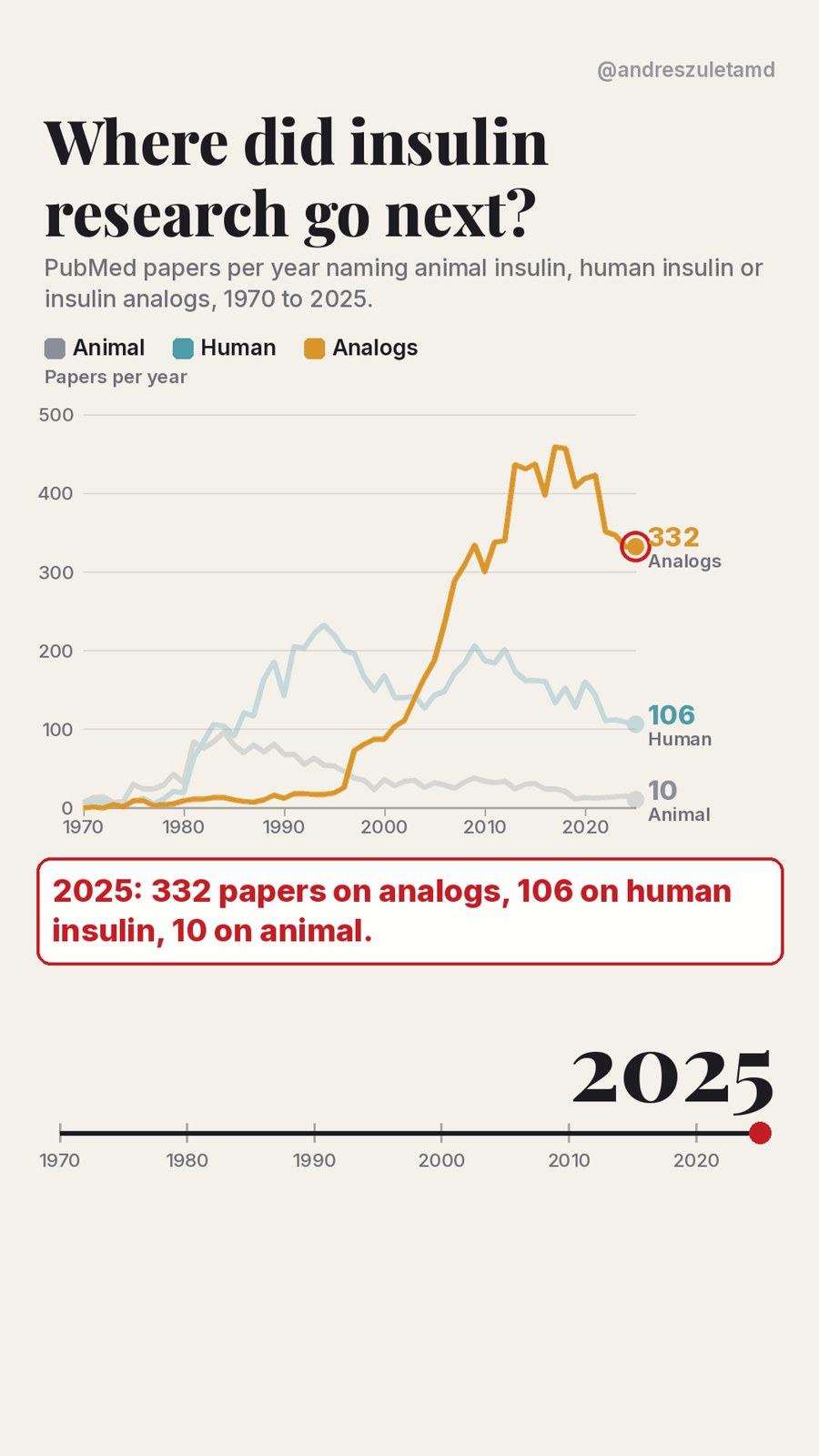
Papers per year naming animal insulin, human insulin or insulin analogs, 1970 to 2025 (NCBI PubMed, searched October 10, 2026).
Where it led
In 1996 the first insulin analog, insulin lispro, was approved. Today peptide manufacturing runs on several platforms: some backbones are produced by yeast fermentation (oral semaglutide's label), others by solid phase synthesis (a current liraglutide label, the Episode 5 method), and teriparatide is a recombinant parathyroid hormone analog. In 1980 Boyer and Cohen shared the Lasker basic research award with Paul Berg and Dale Kaiser.
Want a proactive plan for your own health? Join Thrive Nation.
Sources: Cohen SN et al., PNAS 1973;70:3240; Cohen SN, PNAS 2013;110:15521; Itakura K et al., Science 1977;198:1056; Crea R et al., PNAS 1978;75:5765; Goeddel DV et al., PNAS 1979;76:106; Genentech press release, Sep 6, 1978, and "Cloning Insulin"; S. W. Junod, FDA History Office (2007); FDA Purple Book, BLA 018780; Lasker Foundation, 1980; openFDA labels (insulin lispro, oral semaglutide, liraglutide, teriparatide). Chart data: NCBI PubMed, searched Oct 10, 2026.
Educational only, not medical advice.