Orforglipron: A Physician’s Read on the First Small Molecule GLP-1 Medicine
Andres Zuleta, MD · A physician's read
Until this year, every GLP-1 receptor agonist I prescribed was a peptide. Oral semaglutide made the peptide swallowable with an absorption enhancer and a strict fasting routine. Orforglipron takes the other route: a small nonpeptide molecule that activates the receptor directly.
The pharmacology
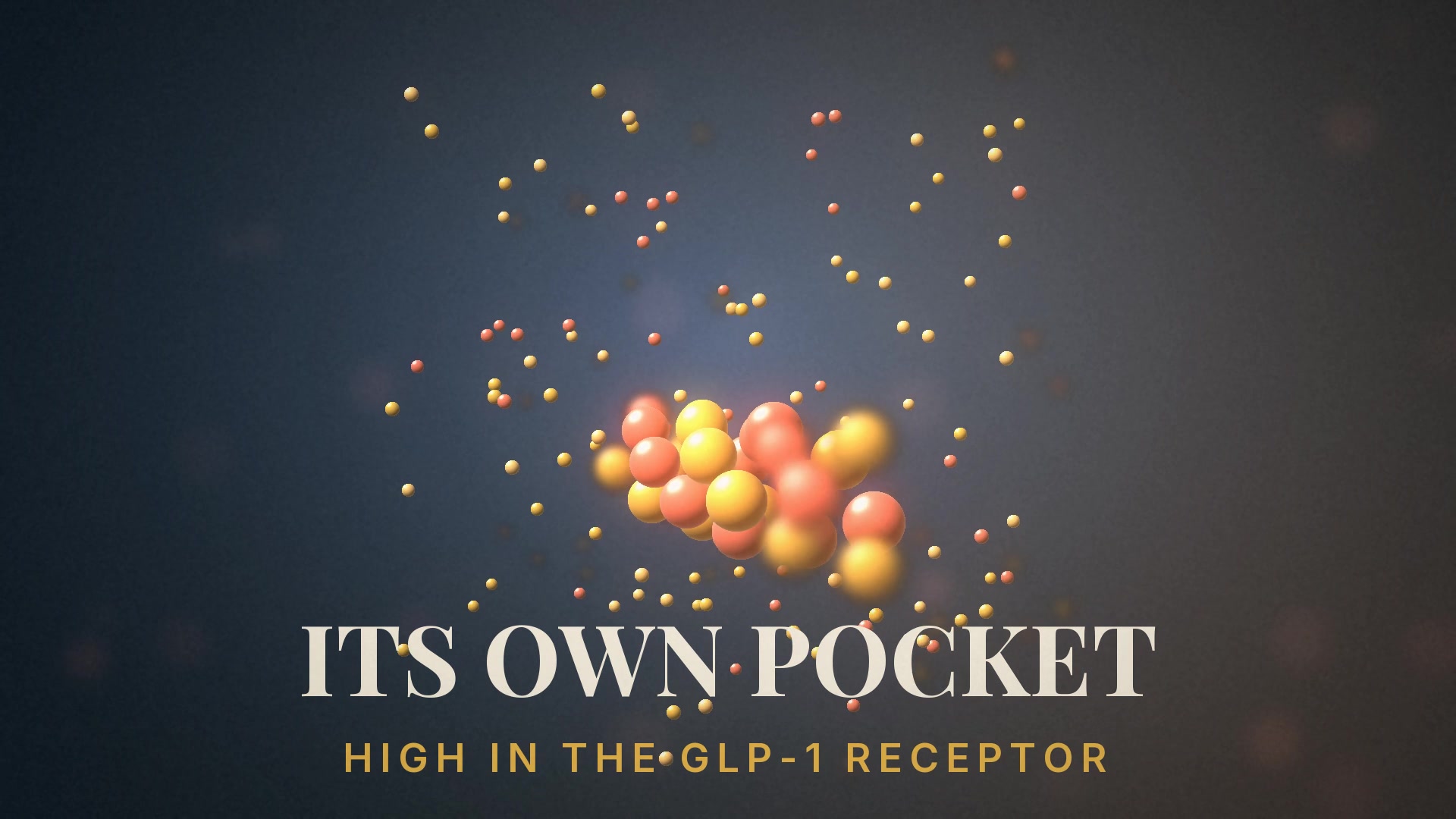
Kawai and colleagues (PNAS 2020, PMID 33177239) described LY3502970 (OWL833, from Chugai Pharmaceutical, developed with Lilly). The cryo-EM structure shows it binding a unique pocket in the upper helical bundle, contacted by the extracellular domain, extracellular loop 2 and transmembrane helices 1, 2, 3 and 7. It is a partial agonist biased toward G protein activation over beta-arrestin recruitment, and its activity depends on the primate-specific Trp33 of the extracellular domain. Its pharmacokinetics suit once-daily oral dosing without food or water restrictions.
The evidence
- Phase 2 (Wharton, NEJM 2023, PMID 37351564): 272 adults without diabetes; at 36 weeks, weight change -9.4% to -14.7% across doses vs -2.3% with placebo.
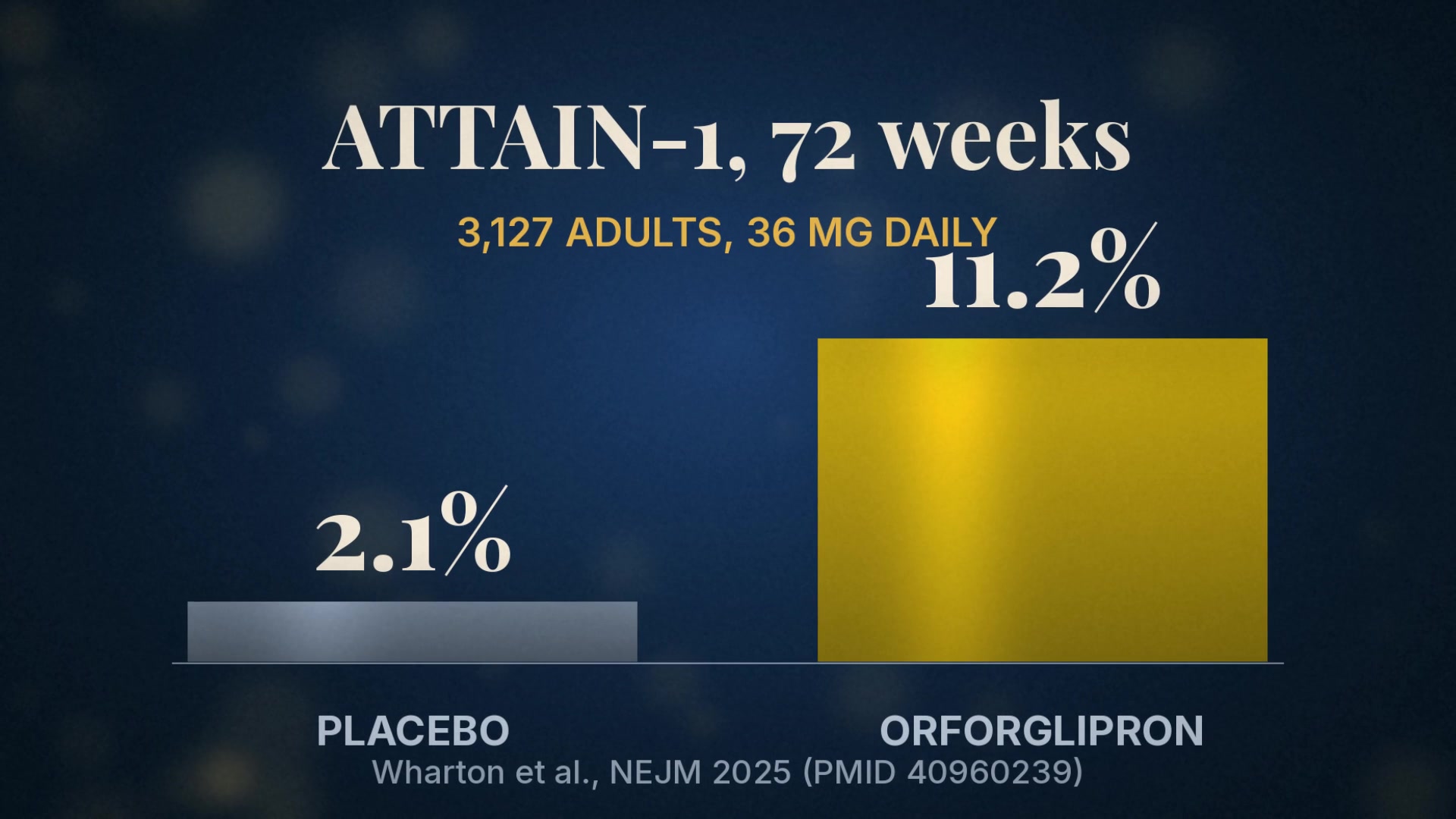
- ATTAIN-1 (Wharton, NEJM 2025, PMID 40960239): 3,127 adults with obesity without diabetes, 72 weeks. Treatment-regimen estimand: -7.5% (6 mg), -8.4% (12 mg), -11.2% (36 mg) vs -2.1%. On 36 mg, 54.6% reached at least 10% and 18.4% at least 20%. Discontinuation for adverse events 5.3 to 10.3% vs 2.7%.
- ACHIEVE-1 (Rosenstock, NEJM 2025, PMID 40544435): 559 adults with early type 2 diabetes, 40 weeks. HbA1c -1.24 to -1.48 points vs -0.41 from a baseline of 8.0%; weight -7.6% at 36 mg; no severe hypoglycemia.
- ACHIEVE-3 (Rosenstock, Lancet 2026, PMID 41765029): 1,698 adults with type 2 diabetes, open label, 52 weeks vs oral semaglutide. HbA1c -1.71 and -1.91 (12 and 36 mg) vs -1.23 and -1.47 (7 and 14 mg); superiority shown for both doses. GI events 58 to 59% vs 37 to 45%; discontinuation for adverse events 9 to 10% vs 4 to 5%; pulse +3.7 to 4.7 vs +1.0 to 1.5 bpm.
- Regulatory: FDA approval for chronic weight management on April 1, 2026 (NDA 220934), the first new molecular entity under the Commissioner's National Priority Voucher pilot.
What I tell patients
- Same receptor, different molecule. Side effects, interactions and long-term evidence do not transfer automatically from the peptide drugs.
- Convenience is real: no fasting routine. But in these trials average weight loss was lower than with the strongest injectables, GI effects were common, and more people stopped than on the semaglutide pill.
- Small molecules bring their own safety questions. Danuglipron was discontinued in April 2025 after a case of potential drug-induced liver injury (Pfizer release).
- These trials were funded by the manufacturer.
For the patient-friendly version, read the ThriveMed post: https://www.thrivemed.us/thrivecityblog/orforglipron-small-molecule-glp1-pill
Sources
- Kawai T et al. PNAS 2020;117:29959 (PMID 33177239).
- Wharton S et al. NEJM 2023;389:877 (PMID 37351564).
- Wharton S et al. NEJM 2025;393:1796, ATTAIN-1 (PMID 40960239).
- Rosenstock J et al. NEJM 2025;393:1065, ACHIEVE-1 (PMID 40544435).
- Rosenstock J et al. Lancet 2026;407:1147, ACHIEVE-3 (PMID 41765029).
- US FDA. Foundayo (orforglipron) approval letter, NDA 220934, April 1, 2026, and press release.
- Pfizer. Update on oral GLP-1 receptor agonist danuglipron, April 14, 2025.
Educational only, not medical advice. Andres Zuleta, MD.