Less Chemo, Better Results: My Read of the Blinatumomab Trial in High-Risk Childhood ALL
By Andres Zuleta, MD
On September 17, 2026, the New England Journal of Medicine published the blinatumomab randomization of AIEOP-BFM ALL 2017. In 709 children and teens with newly diagnosed high-risk B-cell acute lymphoblastic leukemia (ALL), two cycles of blinatumomab replaced two cycles of intensive chemotherapy. At a planned interim analysis, estimated 4-year event-free survival was 83.0% vs 70.3%, and treatment-related infections fell from 69.4% to 23.9%. Here is my read, in four parts: the trial, the results, the drawbacks and the possibilities.
If you want the patient and family version, I wrote that for ThriveMed here: Less chemo, better results for kids with high-risk leukemia? What families should know.
Watch: the 5-minute version
Prefer it shorter? Here is the 52-second version on YouTube Shorts.
1. The trial
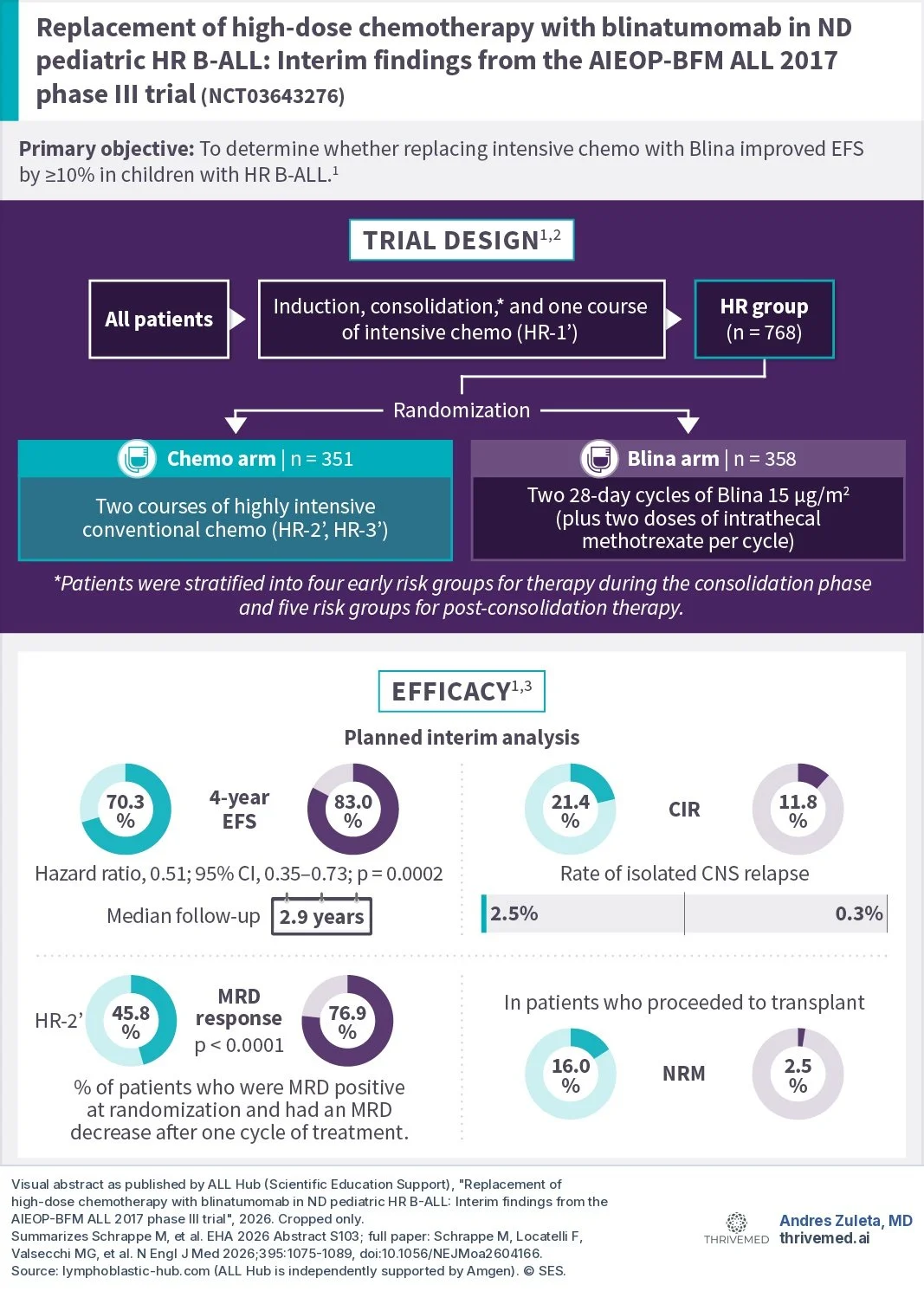
AIEOP-BFM ALL 2017 (NCT03643276) is an investigator-initiated, academic phase 3 program run at more than 100 centers in 8 countries (Australia, Austria, Czechia, Germany, Israel, Italy, Slovakia and Switzerland). The blinatumomab question was asked in patients under 18 with newly diagnosed high-risk B-cell ALL.
Randomization: 709 of 768 eligible patients (92.3%) were randomized 1:1 after consolidation: 358 to blinatumomab and 351 to chemotherapy.
Intervention: two cycles of blinatumomab (15 µg/m²/day by continuous infusion, 28 days per cycle, with intrathecal methotrexate) in place of two cycles of intensive chemotherapy.
Primary endpoint: event-free survival, with events defined as resistance, relapse, second malignancy or death. The trial was designed to detect a 10 percentage point improvement in 4-year EFS.
This report: a planned interim analysis at a median follow-up of 2.9 years.
Visual abstract, design and efficacy: ALL Hub, Scientific Education Support (SES), 2026, summarizing Schrappe M, et al., EHA 2026 Abstract S103. ALL Hub is independently supported by Amgen. © SES. Shown as published, cropped only. Its MRD response figure uses a different definition from the NEJM paper, and its post-transplant NRM figure is conference-only; I do not use either below.
2. The results
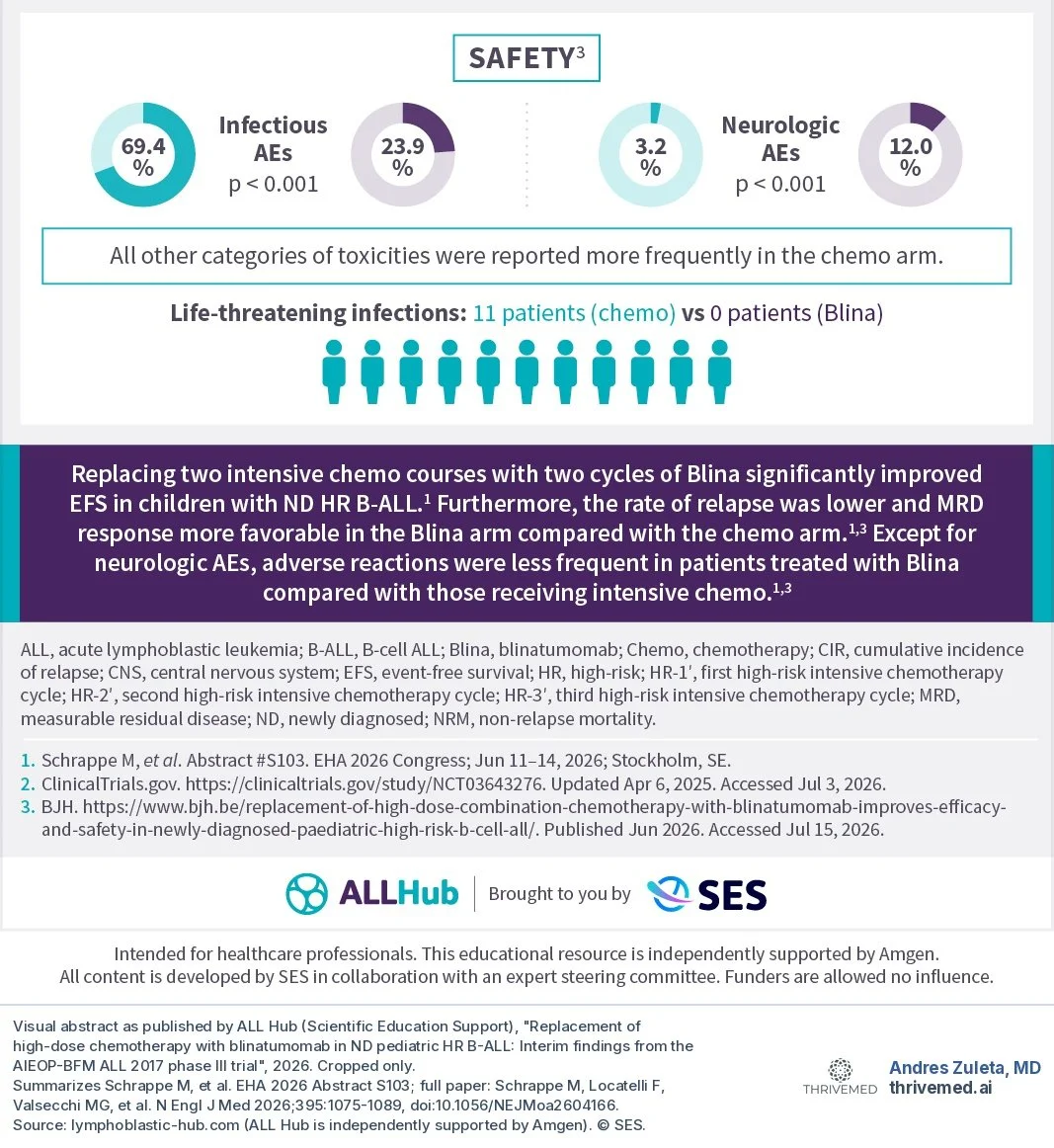
OutcomeBlinatumomabChemotherapySource4-year event-free survival83.0% (95% CI 77.4 to 87.4)70.3% (63.8 to 75.9)NEJM, P = 0.0002Hazard ratio for an event0.51 (0.35 to 0.73)referenceNEJM4-year cumulative incidence of relapse11.8%21.4%EHA 2026 and paper summaryIsolated CNS relapse0.3%2.5%EHA 20264-year overall survival93.6%91.0%Paper summary, not significantly differentTreatment-related infection23.9%69.4%NEJM, P < 0.001Life-threatening adverse events2 (0.5%)16 (4.7%)NEJMNeurotoxic events12.0%3.2%NEJM, P < 0.001Cytokine release syndrome, grade 2 or higher1.1%n/aNEJM
In plain numbers: about half the risk of an event, relapses nearly halved, and about a third as many treatment-related infections. There was one fatal adverse event (0.3%) in the blinatumomab group.
Visual abstract, safety: same source and credit as above (ALL Hub, SES, 2026; © SES; shown as published, cropped only).
3. The drawbacks
Interim analysis. These are interim data at 2.9 years of median follow-up. Interim analyses can overestimate effect sizes, so longer follow-up will matter.
Overall survival is not yet different. 93.6% vs 91.0% at 4 years is not statistically significant. Survival was high in both groups.
Neurotoxicity. Neurotoxic events were about 4 times as common with blinatumomab (12.0% vs 3.2%), and the mechanism is not fully understood. This is the trade-off families will need to hear about up front.
Logistics. Continuous 28-day infusions mean a pump, line care and close outpatient follow-up.
Open questions. The optimal timing of blinatumomab is not established, and the subgroup analyses were post hoc and small.
Conflicts. The trial was academic, funded by Deutsche Krebshilfe and others, but some authors are employees of Amgen, the drug's maker.
4. The possibilities
According to the trial leaders, this is the first time an immunotherapy has replaced part of the especially burdensome first-line chemotherapy in childhood ALL. The accompanying NEJM editorial by Myers and Hunger called blinatumomab "a new standard of care" in B-cell ALL, and noted that the hazard ratio of 0.51 mirrors what has been seen in other populations. If the benefit holds with longer follow-up, the larger shift may be in what we can take away: less intensive chemotherapy, fewer infections and fewer hospital days for these children. A follow-on study is planned. That is a could, not a promise.
Questions I would ask the care team
My opinion, not a finding of the trial:
Does this patient meet the trial's high-risk definition, and is blinatumomab part of the current protocol?
How will neurotoxicity be monitored, and what is the plan if it occurs?
What does home infusion support look like for this family?
Be proactive. More on proactive care at thrivemed.ai.
References
Schrappe M, Locatelli F, Valsecchi MG, et al.; AIEOP-BFM ALL 2017 Consortium. Blinatumomab for Replacing Chemotherapy in Pediatric Acute Lymphoblastic Leukemia. N Engl J Med 2026;395(11):1075-1089, published September 17, 2026. doi.org/10.1056/NEJMoa2604166 (free abstract: PubMed 42748428)
Myers RM, Hunger SP. Blinatumomab, A New Standard of Care in Acute Lymphoblastic Leukemia. N Engl J Med 2026 (editorial). doi.org/10.1056/NEJMe2610500
Schrappe M, et al. Blinatumomab in pediatric high-risk B-ALL: AIEOP-BFM ALL 2017. EHA 2026 Congress, plenary abstract S103, June 13, 2026.
Visual abstract: ALL Hub, Scientific Education Support, 2026.
Educational only, not medical advice. Approximations ("about half", "nearly halved", "about 4 times", "about a third") are rounded from the published figures shown alongside them.