The Counterintuitive Third Agonist: A Physician's Read on Glucagon, Retatrutide and TRIUMPH
Andres Zuleta, MD · A physician's read
Glucagon is the hormone we reach for when blood sugar is too low. Building it into an obesity and diabetes drug looked, at first glance, like the wrong direction. The rationale is that glucagon receptor agonism adds energy expenditure and hepatic lipid handling, while the incretin arms cover appetite and glycemia.
Day and colleagues (DiMarchi and Tschöp groups, 2009) showed that a GLP-1 and glucagon co-agonist normalized adiposity in diet-induced obese mice through lower intake and higher energy expenditure. Finan and colleagues (2015) built a balanced triagonist; loss of function models assigned energy expenditure to the glucagon arm, intake and glycemia to GLP-1, and a buffering role against glucagon's diabetogenic effect to GIP.
The trial record:
- Phase 2, obesity (338 adults, 48 weeks): -8.7%, -17.1%, -22.8% and -24.2% at 1, 4, 8 and 12 mg vs -2.1% on placebo; 83% on 12 mg lost 15% or more. GI events were dose related and eased with a lower starting dose; heart rate rose dose dependently, peaking at 24 weeks.
- Phase 2, type 2 diabetes (281 people): HbA1c down up to 2.02 points at 24 weeks vs 1.41 on dulaglutide 1.5 mg.
- Liver fat substudy (98 people with MASLD): relative liver fat change -82.4% at 24 weeks on 12 mg vs +0.3%; 86% reached normal liver fat.
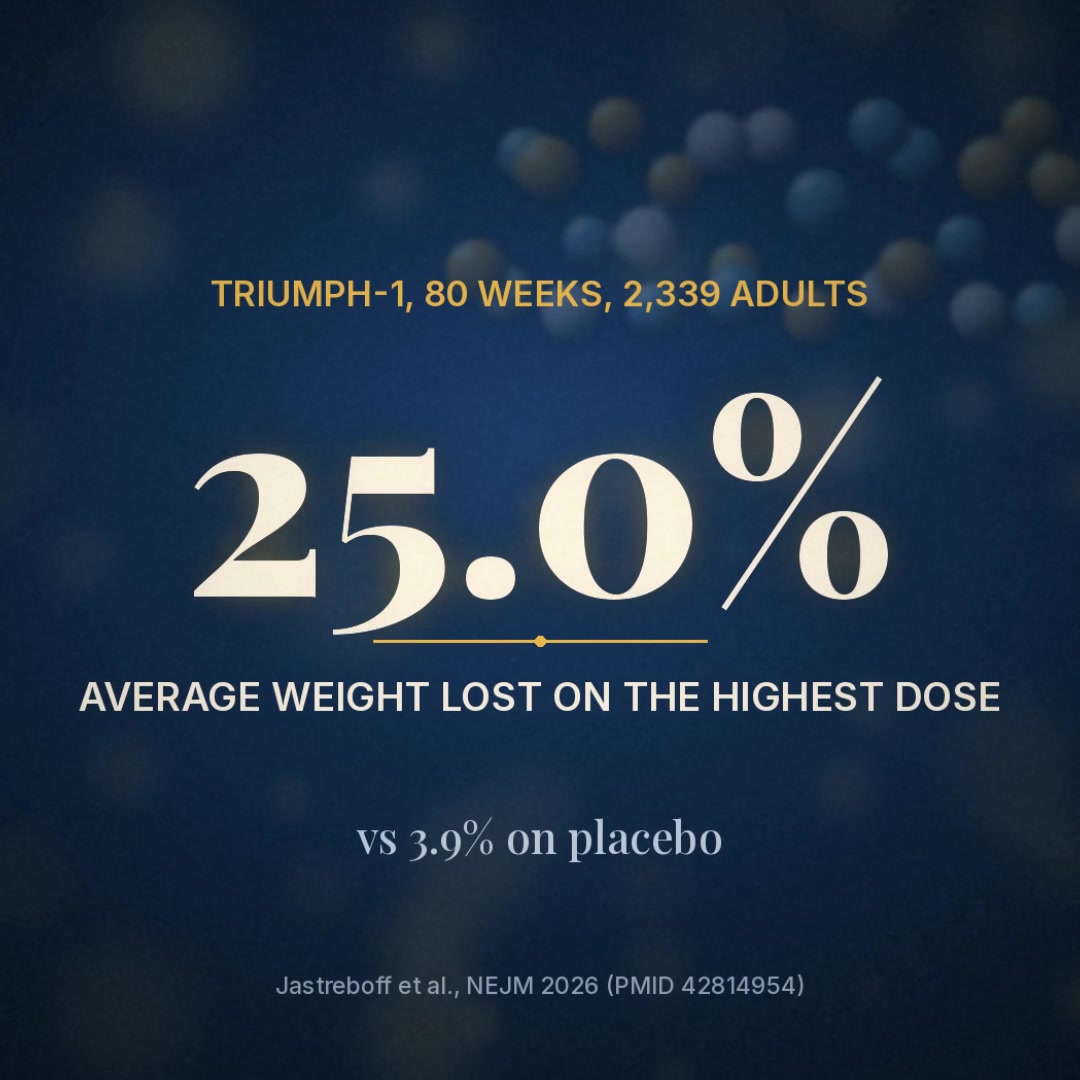
- TRIUMPH-1 (2,339 adults without diabetes, 80 weeks, treatment regimen estimand): -17.6%, -23.7% and -25.0% at 4, 9 and 12 mg vs -3.9%; improvements in WOMAC pain (knee osteoarthritis subgroup) and apnea-hypopnea index (OSA subgroup).
- TRIUMPH-2 (1,152 adults with obesity and type 2 diabetes, 80 weeks): -18.8% on 12 mg vs -5.1%; nausea 28% vs 8%, dysesthesia 7% vs 1%, hypotension 6% vs under 1%.
What I take from it: the glucagon arm appears to add something the incretins alone do not, especially in the liver. But the safety signals deserve attention (heart rate, dysesthesia, hypotension, discontinuation at the top dose), every trial so far is sponsor funded, and we do not yet have cardiovascular outcome data or off treatment data. Retatrutide is investigational; products sold online under its name are not the trial drug.
The patient version, with the full story and every source, is on the ThriveMed blog: https://www.thrivemed.us/thrivecityblog/one-molecule-three-hormones-glucagon-retatrutide-triumph
Sources
- Day JW, et al. Nat Chem Biol 2009;5:749. PMID 19597507.
- Finan B, et al. Nat Med 2015;21:27. PMID 25485909.
- Coskun T, et al. Cell Metab 2022;34:1234. PMID 35985340.
- Rosenstock J, et al. Lancet 2023;402:529. PMID 37385280.
- Jastreboff AM, et al. N Engl J Med 2023;389:514. PMID 37366315.
- Sanyal AJ, et al. Nat Med 2024;30:2037. PMID 38858523.
- Jastreboff AM, et al. TRIUMPH-1. N Engl J Med 2026. PMID 42814954.
- Bellido V, et al. TRIUMPH-2. Lancet 2026;408:1455. PMID 42810372.
Educational only, not medical advice. Andres Zuleta, MD.